
In one of the scariest moments in modern history, we're doing our best at ScheerPost to pierce the fog of lies that conceal it but we need some help to pay our writers and staff. Please consider a tax-deductible donation.
By Austin Sarat for ScheerPost
It is hardly news that America’s colleges and universities are in serious trouble. Declining public confidence, politically motivated attacks, and the withdrawal of government funding have all contributed to a deepening crisis in higher education.
Last month, the New York Times offered new evidence of that crisis, reporting that “American universities are falling farther behind their global peers.” We are witnessing the emergence of “a new world order in global dominance of higher education and research.” China’s universities are now assuming roles once held by their American counterparts, leading the world in research output and attracting top talent from across the globe.
This should be as shocking to our generation as the Soviet Union’s launch of Sputnik was in 1957. Our Sputnik moment is less visible and less dramatic, but no less consequential.
The future of this country will depend on how we respond — and academic freedom is central to that response.
Now more than ever, America needs fearless, inventive, forward‑looking academic inquiry to push the boundaries of knowledge. It also needs renewed investment to support that enterprise.
Almost 70 years after Sputnik, we cannot expect the government to fully come to the rescue. To meet today’s challenge, universities must attract new investors and energize those already providing support. Doing so will require new models of governance and a new attitude toward those who fund higher education. Instead of treating donors as mere deep pockets, colleges and universities will need to engage them as thought partners. This will not be easy or comfortable, but without such changes, our institutions will continue to fall further behind.
According to the Times, “Until recently, Harvard was the most productive research university in the world. … That position may be teetering, the most recent evidence of a troubling trend for American academia.” Phil Baty, chief global affairs officer for Times Higher Education, notes that “It’s not as if U.S. schools are getting demonstrably worse, it’s just the global competition: Other nations are making more rapid progress.”
China’s Education Master Plan (2024–2035) is one example. It explicitly aims to make Chinese universities the world’s leading institutions.
Harvard Professor Ariel Procaccia has questioned the validity of rankings that elevate Chinese universities, but it is indisputable that higher education in this country is in serious trouble.
As American universities fall behind, the quality of American life will decline. Investments in higher education pay off in countless ways: improving health care, shaping public policy, and generating innovations that drive the private sector. We learned this lesson after Sputnik, which triggered a rapid, all‑hands‑on‑deck national response. A Harvard study notes that Sputnik served as a “focusing event” that spotlighted a national problem. Congress responded with the National Defense Education Act, dramatically increasing funding for education at all levels, including low‑interest loans for college students, with a focus on scientific and technical fields.
Today, instead of helping universities prosper and compete, political leaders score points by denigrating and attacking them. Instead of supporting academic freedom, some seek to curtail it.
The Times examined National Institutes of Health funding and found that “thousands of very competitive projects in areas like cancer, diabetes, aging, neurological disorders and public health improvements probably went unfunded in 2025.” Federal support for training new scientists in graduate programs has also declined sharply. At the moment, there is little we can do to persuade the government to reverse course.
But this is no time for hand‑wringing. We are once again at an all‑hands‑on‑deck moment. Only this time, colleges and universities themselves must lead the charge. To do so, they must acknowledge the problems that have eroded public confidence and offer more than perfunctory mea culpas.
Today’s colleges and universities are like undervalued properties in need of new investors. To attract them — and to sustain academic freedom — institutions must change how they do business.
Instead of a “please give us money but leave us alone” approach, they must embrace a partnership model with supporters. This does not mean allowing donors to dictate policy or infringe on academic freedom. Many universities already partner successfully with private industry; the models exist. Those models show that universities must understand what potential partners stand for and what positions they take, and they must find modes of cooperation that advance shared goals without compromising the core values of higher education.
The same applies to fundraising from other sources. Universities must adapt to a giving environment in which donors expect their dollars to have significant, real‑world impact. Ironically, the withdrawal of federal support creates new opportunities for universities to demonstrate that impact.
But they can seize those opportunities only if they are willing to reimagine their relationships with those whose support they need now more than ever.
Academic freedom is not free. It depends on a complex infrastructure: laboratories, studios, research centers, and the quiet spaces where scholars pursue truth in their offices and libraries.
Whatever happens next, one thing is clear: our ability to respond effectively to this new Sputnik moment depends on our willingness to support our colleges and universities — and to sustain the academic freedom that makes their work possible.
Austin D. Sarat is the William Nelson Cromwell Professor of Jurisprudence and Political Science at Amherst College. He is an internationally renowned scholar whose interdisciplinary work examines law in relation to culture, violence, and the liberal arts. His academic foundation includes a B.A. from Providence College (1969), an M.A. (1970) and Ph.D. (1973) from the University of Wisconsin, and a J.D. from Yale Law School (1988). He has also received honorary degrees, including an LL.D. from Providence College (2008) and an A.M. from Amherst College (1984). Sarat has also been awarded the Jeffrey B. Ferguson Memorial Teaching Prize at Amherst in 2022 and the Ronald Pipkin Service Award as well as many others
For more about our original academic freedom collection—including additional work from Professor Sarat—visit here. Here is our latest on the subject:
-
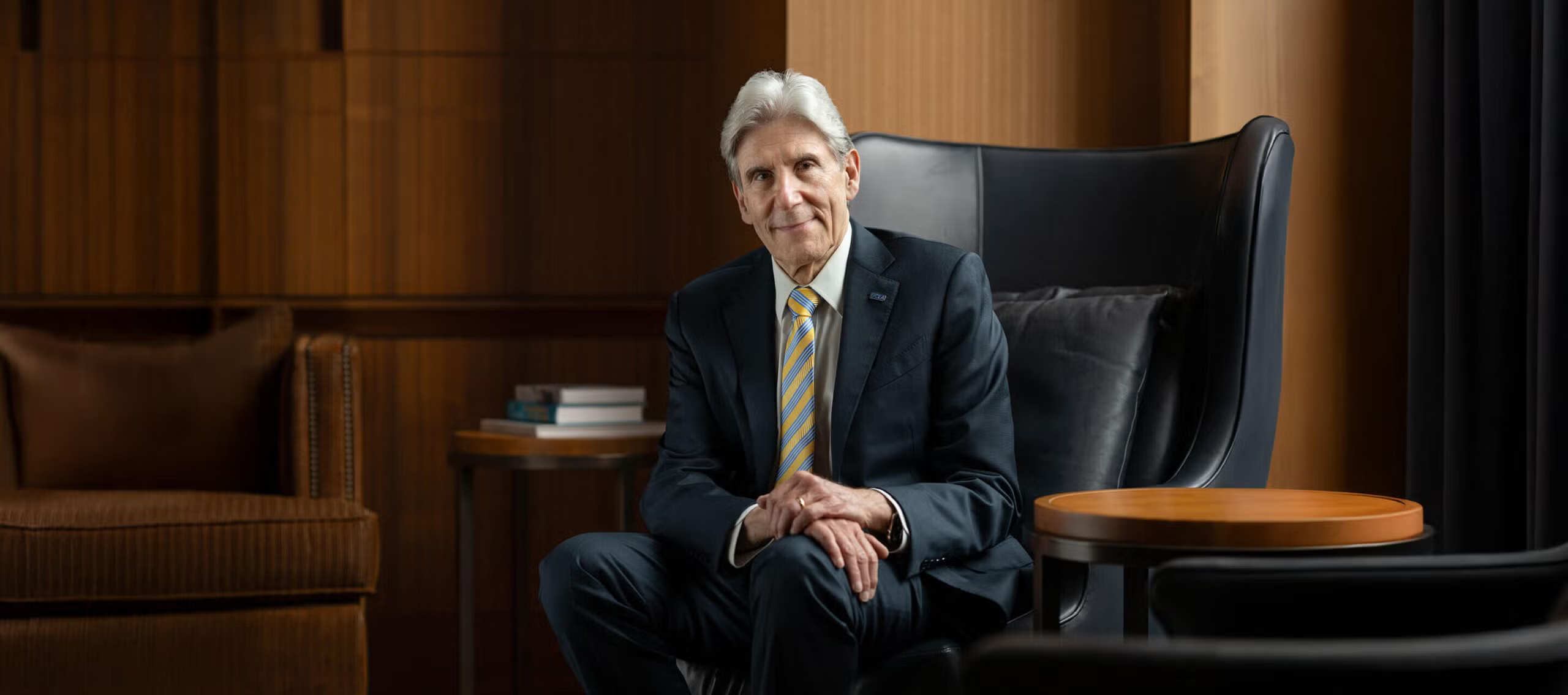
UCLA Faculty Push Back As Chancellor’s 9/11 Statement Raises New Questions About Academic Freedom
-

Thanks to Trump, College and University Presidents Have Accrued Even More Power on Their Campuses
-

How Universities Should Respond To Revelations That The Trump Administration’s Antisemitism Charges Were a Sham
-

In Support Of Dr. Tiffany Willoughby-Herard