In one of the scariest moments in modern history, we're doing our best at ScheerPost to pierce the fog of lies that conceal it but we need some help to pay our writers and staff. Please consider a tax-deductible donation.
Russia and China failed to veto a resolution that blatantly blamed the victim rather than the aggressor in the war against Iran.
Neither Russia nor China vetoed a U.N. Security Council resolution on Wednesday that turned the tables on the war, falsely identifying Iran as the instigator of hostilities.
The resolution’s preamble expressed “grave concern at the recent escalation of violence in the region, particularly the missile and drone attacks launched by the Islamic Republic of Iran against” the Arab Gulf states and Jordan “which targeted residential areas and civilian objects, resulting in civilian casualties and damage to civilian infrastructure.”
The operative paragraphs say the Security Council:
Condemns in the strongest terms the unprovoked and egregious attacks by the Islamic Republic of Iran against the territories of Bahrain, Kuwait, Oman, Qatar, Saudi Arabia, the United Arab Emirates, and Jordan;
Demands the immediate and unconditional cessation of these hostilities and all provocations, threats, and the use of regional proxies by Iran;
Calls upon all parties to exercise maximum restraint and to refrain from any further actions that could escalate the situation;
Affirms the inherent right of the affected States to individual or collective self-defence in response to these attacks, in accordance with Article 51 of the Charter;
The most startling word in the resolution is “unprovoked,” which any clear-eyed observer would see as an out-and-out lie.
It was sheer audacity to include that word when the whole world can see that the United States and Israel carried out an unprovoked attack and that Iran is defending itself according to the U.N. Charter. The demand that Iran stop using its proxies to help defend itself is egregious.
This resolution brings further shame on the Security Council after its endorsement last November of the genocidal Trump/Kushner takeover of Gaza.
Wednesday’s resolution passed by 13-0-2, with Russia and China abstaining. Either of the two veto-wielding powers could have killed it.
China said the sovereignty of the Gulf states must be respected, but the resolution “does not fully reflect the root cause and overall picture of the conflict in a balanced manner.”
After its passage, a Russian draft resolution was put before the Council. It was a reasonable, neutral measure calling for an end to the war:
“Recalling Article 2(4) of the Charter of the United Nations, which prohibits the use of force against the territorial integrity or political independence of any State,
Expressing its deep concern over the current military escalation in the Middle East and beyond,
Mourning the tragic loss of life throughout the ongoing hostilities in the region,
Urges all parties to immediately stop their military activities and refrain from further escalation in the Middle East and beyond;
Condemns in the strongest terms all attacks against civilians and civilian infrastructure, and calls for their protection, underscoring the obligations of all parties under international law, including international humanitarian law;
Underlines the importance of ensuring security of all States in the region of the Middle East and beyond;
Strongly encourages all parties concerned to return to negotiations without any further delay and to make full use of political and diplomatic means.”
The Russian draft failed to get the required nine votes, garnering only 4 in favor, 2 against and 9 abstentions. Russia, China, Pakistan and Somalia voted in favor. The U.S. and Latvia voted against.
Russia’s Abstention
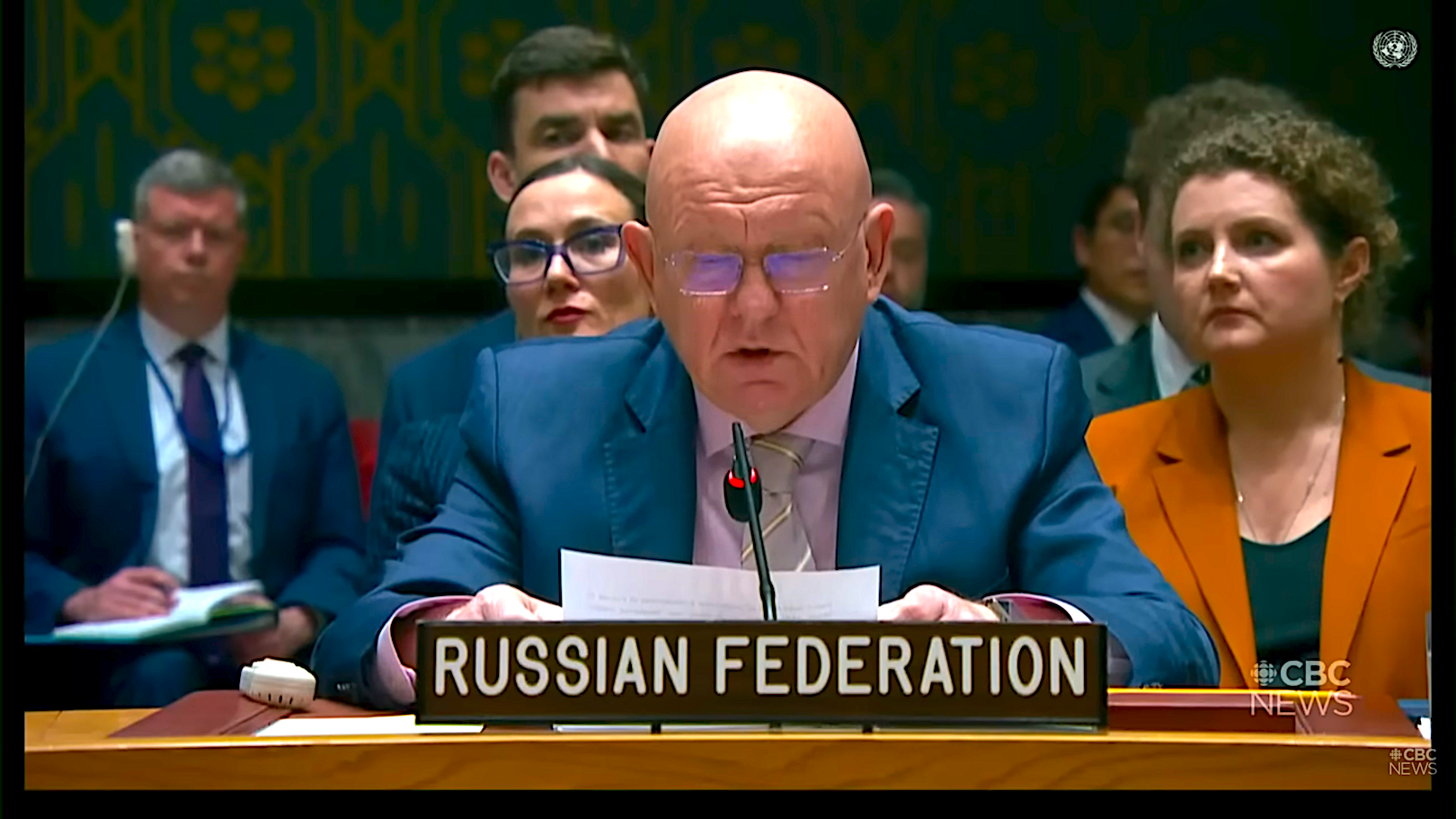
Russian Ambassador Vasily Nebenzya at U.N. Security Council on March 11, 2026. (CBC screenshot from U.N. TV feed).
Inside the Security Council chamber after the vote, Vasily Nebenzya, the Russian ambassador to the U.N., said:
“The Russian Federation abstained in the vote on the draft resolution tabled by Bahrain because it is extremely unbalanced and does not serve the purposes of maintaining international peace and security. … Russia deems unacceptable any strikes on the territory of Arab States in the Persian Gulf, in particular on civilian infrastructure there. …
However, it would be impossible and unfair to talk about attacks on countries in the region without regard for the root causes of the current escalation, namely the aggression of the US and Israel against Iran.
To our deep regret, the resolution that has just been adopted is framed precisely in such a biased and one-sided tone. It muddles up the cause and effect. If someone who is not well versed in international affairs reads this resolution, they will inevitably get the impression that Tehran, willingly and out of malice, conducted an unprovoked attack on Arab countries.
At the same time, the attacks against the territory of Iran itself, let alone those who are behind them and carrying them out, are not only not condemned in the document but simply left out. And the Security Council has just signed off on this.”
Though Nebenzya said Russia deemed Iran’s retaliatory attacks on the Gulf states “unacceptable,” he went on to explain how the U.S. was using the territory of those states for its attacks against Iran, despite denials from the Gulf Arab countries and the U.S.
That made Russia’s abstention even more perplexing.
Nebenzya said:
“[The resolution] does not mention the fact that the authorities in Tehran have repeatedly emphasized that their retaliatory actions are directed not against the countries in the region, but against U.S. military facilities and infrastructure located on their territory, and are legitimate targets within Iran’s right to self-defense under Article 51 of the UN Charter.
We can’t but note that Washington, through its aggressive actions, has essentially set up the countries of the Gulf Cooperation Council (GCC). The U.S. ignored the repeated requests of Arab States not to use their territory to conduct military operations against Iran.
According to the information we receive from open sources, the U.S. is actively using its permanent military bases for this purpose, first and foremost those deployed in the monarchies of the Persian Gulf: and these bases are being used not for defensive or reconnaissance purposes, but rather for offensive ones.
On Feb. 28, the official website of the US Central Command (CENTICOM), citing its head Adm. Brad Cooper, reported that high-precision weapons had been launched against Iranian territory not only from air and sea, but also from land. Obviously, this could only be the reference to the territory of countries neighboring Iran.”
Asked at a media stakeout after the vote about the disappointment to Iran and its supporters that Russia’s absention had caused, Nebenzya, somewhat defensively, said:
“There are many disappointments in the world on many issues. We recognized that the Gulf countries suffers … not just the American bases located in these countries, but the civilians and the civilian infrastructure, which we do not appreciate at all, and we understand the sentiment of the Gulf countries. But the problem is that, as I said, the cause of the consequences in the resolution are put upside down.”
TRANSLATION: This whole catastrophe is the fault of Israel and the U.S. but we want to stay on the good side of the billionaire Gulf Arabs who were dragged into this, so we abstained.
As Iran is a BRICS member whose most powerful members are Russia and China, it was at the very least a lack of solidarity with a fellow member, Iran. Moscow and Beijing’s abstention is another crack in the BRICS wall after the split between India and Russia over New Delhi’s open support for Israel.
Asked what kind of help to resolve the war that Russia is contemplating giving — which Vladimir Putin mentioned to Donald Trump in a phone call on Wednesday — Nebenzya said: “Help is not appeasement. We are calling a spade a spade. But we are ready to help to get out of the dire situation the whole region and [that] the United States itself got itself into.”
Asked why neither resolution named the perpetrators — Israel and the United States — the Russian envoy said:
“Two things: First, there is a convention in the Security Council … that no permanent member will ever veto, will ever vote against itself in a resolution that mentions its name. That’s life. You may laugh at it but this is how it works. Secondly, we proposed amendments that didn’t mention the name, but offered solutions. So we didn’t violate either the convention or the essence.”
Joe Lauria is editor-in-chief of Consortium News and a former U.N. correspondent for The Wall Street Journal, Boston Globe, and other newspapers, including The Montreal Gazette, the London Daily Mail and The Star of Johannesburg. He was an investigative reporter for the Sunday Times of London, a financial reporter for Bloomberg News and began his professional work as a 19-year old stringer for The New York Times. He is the author of two books, A Political Odyssey, with Sen. Mike Gravel, foreword by Daniel Ellsberg; and How I Lost By Hillary Clinton, foreword by Julian Assange.
Editor’s Note:At a moment when the once vaunted model of responsible journalism is overwhelmingly the play thing of self-serving billionaires and their corporate scribes, alternatives of integrity are desperately needed, and ScheerPost is one of them. Please support our independent journalism by contributing to our online donation platform, Network for Good, or send a check to our new PO Box. We can’t thank you enough, and promise to keep bringing you this kind of vital news.