
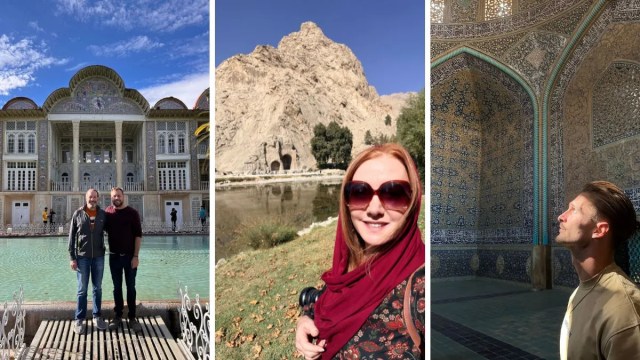
Since the beginning of the U.S.-Israeli war on Iran, officials in Washington and Tel Aviv have made several inflammatory statements about the country. “A whole civilization will die tonight,” President Donald Trump posted on Truth Social on April 7. With the spike in the U.S. government’s deportation of Iranian nationals and the hardening of corporate media narratives, the conflict has exceeded what was presented as a showdown with the government in Tehran, evolving into hostility against the Iranian people.
Despite decades of Western media disparaging Iran and withholding crucial information about the country’s history and culture, a growing number of travelers from the U.S. and Europe are venturing to Iran in the face of ongoing security challenges, hoping to learn about the country firsthand.
Travel videos and photographs from Iran have been circulating widely on social media in the wake of the war, often showing a side of the country that first-time visitors say breaks with their expectations.
“So much of what we see coming out of Iran is the same imagery and the same stories, politics, protests, arrests, and women in black chadors, as though that one image somehow represents every woman and every part of Iran,” said Carrie Patsalis, a British internet personality whose videos from an October 2025 visit to Iran clocked hundreds of thousands of views.
Before her trip, Patsalis didn’t tell most of her friends and relatives about her travel plans, because she expected negative reactions. Her parents were particularly concerned about her safety.
“As I started sharing photos and videos from the trip, I think my family were almost confused at first. Both of my parents said, ‘I can’t believe that’s Iran,’” she told Prism in an email. “They were seeing cafés, beautiful architecture, families out together, young people, mountains, incredibly friendly people—all the normality that rarely makes the news.”

Patsalis, co-founder of the digital content company Mad Cat Media, published Instagram and YouTube roundups touring Isfahan’s iconic mosques, canoeing at the Ali-Sadr Cave in Hamedan, and exploring the ancient rock reliefs of Taq-e Bostan in Kermanshah. Her posts generated millions of impressions.
Patsalis named Isfahan her favorite Iranian city. The city is known for its traditional crafts, including carpet-weaving, metalwork, and woodwork.
“I was welcomed into little shops to watch these incredibly talented artisans at work, from jewelry-making to copper work, and several of them told me how much they wished more international visitors would take the plunge and come,” Patsalis said.
Iran has a long history and is home to 30 UNESCO World Heritage Sites, including Persepolis, Isfahan’s historic center known as the Naqsh-e Jahan Square, and the Persian Gardens. Still, it remains a difficult destination for many Western travelers. Decades of tense relations with major powers, Tehran’s arbitrary restrictions on visitors, and stereotypical media portrayals have worked in tandem to discourage holidaymakers from visiting the country.
In 2025, Iran recorded 6.9 million international tourist arrivals, according to the U.N., down slightly from 7 million visitors a year earlier. This is a relatively small figure compared to other countries in the region, where the economy relies heavily on tourism and hospitality sector revenues.
Yet, the number of travelers from English-speaking and other Western countries organizing cultural tours to Iran is slowly increasing. In some cases, American and British adventurers like Patsalis have visited Iran even after the 12-Day War last June, and some are organizing fall trips despite the uncertain future of the U.S.-Israeli military campaign.

Chris Joondeph is a marketing specialist from Denver who lives in Nigeria, where he runs a travel company specializing in tours across Africa. He visited Iran in February 2023. His social media videos immediately went viral, and some have resurfaced since U.S. and Israeli airstrikes killed Iran’s supreme leader Ali Khamenei and other top Iranian officials in February.
“You obviously hear a lot of bad things in the media, how it’s extremely dangerous, it’s unsafe, you can’t go there,” Joondeph told Prism. “I’ve traveled a lot, so I’ve seen how media perceptions aren’t the case, but what really surprised me the most was probably how developed Iran was and how strong the country was, just in terms of being a really developed and strong economy despite all of the sanctions.”
The U.S. and European Union have imposed extensive sanctions on Iran over its nuclear program, regional activities, and other political disputes. The sanctions have contributed to hyperinflation and currency devaluation. Its financial sector is cut off from the world, and ordinary Iranians have been denied access to imported medicine, agricultural goods, and civil aviation technology, among other products.
Some of Joondeph’s popular videos include those showing local artisans in Isfahan engraving designs into metal, a 1,500-year-old Zoroastrian fire temple in Yazd, and local Persian cuisines he tried in different cities.
Joondeph was surprised by the response. Iranians living in the country were excited to see Iran through the eyes of an American traveler. Many Americans were caught off guard that the country they were told was an adversary didn’t look like what they had assumed. And, there were Iranians in the diaspora whose response was a “self-righteous pushback,” according to Joondeph, as they argued his visit equaled support for the embattled Iranian government.
The former NCAA linebacker Keyen Lage, who has been traveling to lesser-known destinations for several years, believes relations between governments, even at this time of military confrontation, should not affect how people interact with each other. He visited Iran in November and was impressed by the hospitality he encountered.

“I actually received a lot more love because I was American, compared to maybe some other countries, because they have a good, positive feeling towards us while I was there,” Lage told Prism. “I didn’t get any negative feedback, because the people understood that it was a government-to-government war, not a people-versus-people war.”
Like most other visitors, Lage appreciated the chance to see the ruins of the ceremonial capital of the Achaemenid Empire in southwestern Iran, known as Persepolis. Located on the outskirts of Shiraz, the palace was incinerated by Alexander the Great during the Battle of the Persian Gate in 330 BCE.
“I absolutely loved going to Persepolis. I thought it was amazing learning about the culture there. I did a meditation while I was there, and that was so powerful,” Lage said.
As the war continues with the Trump administration enforcing an illegal naval blockade and fresh economic sanctions on Iran, the gap between the Iranian people and the world remains difficult to bridge. Other than independent travelers seeking to challenge the common misconceptions, it is unlikely that many people would be encouraged to visit anytime soon.
“The thing I’ll probably remember most is how different the Iran I experienced was from the Iran I had imagined,” Patsalis said. “I went expecting to feel nervous and slightly on edge, and instead I came away thinking about its people, its beauty, its history and how much of it the rest of the world simply never gets to see.”
Editorial Team:
Sahar Fatima, Lead Editor
Carolyn Copeland, Top Editor
Rashmee Kumar, Copy Editor
Kourosh Ziabari is an award-winning journalist based in New York. His work has appeared in New Lines Magazine, Foreign Policy, UnHerd, Politico, and The American Conservative.
Editor’s Note: At a moment when the once vaunted model of responsible journalism is overwhelmingly the play thing of self-serving billionaires and their corporate scribes, alternatives of integrity are desperately needed, and ScheerPost is one of them. Please support our independent journalism by contributing to our online donation platform, Network for Good, or send a check to our new PO Box. We can’t thank you enough, and promise to keep bringing you this kind of vital news.
You can also make a donation to our PayPal or subscribe to our Patreon.