
Form (not genre) is the key to understanding literature that opens cracks in conventional understanding. But exactly what form is is unknowable. Goethe said there was “an open mystery” to every form. One either senses it or not. It comes with a thrill of recognition.
As Roberto Calasso puts it, it is “by a certain vibration or luminescence of the sentence” or whole that one catches it and “a sort of second reality opens out beyond that other reality where everyone has agreed on the conventions that make the world machine go round.”
And Nietzsche asked and answered, “What is the truth? A mobile army of metaphors.” These metaphors are rooted in mystery and they transport us to the myths by which we live, often unknowingly to ourselves.
“Her mind was a bed already made up.”
Meaning is always found in-between; words are birds; and we are tight rope walkers.
Today, the art of writing has been boxed into categories meant to conform to the tralatitious world; to exclude what the English writer John Berger calls “enclaves of the beyond.” To snuff out fighters who resist this. Without a fighting spirit, life will defeat you. You will become a gruesome genre. Glance around the world. To whom can we turn when we need a jolt to rouse us from the public echo chamber?
We need inspiration. We need to learn from those who have graduated from the College of Hard Knocks and the poets who sing like nightingales. We need cracks in the concrete that encases our reactions.
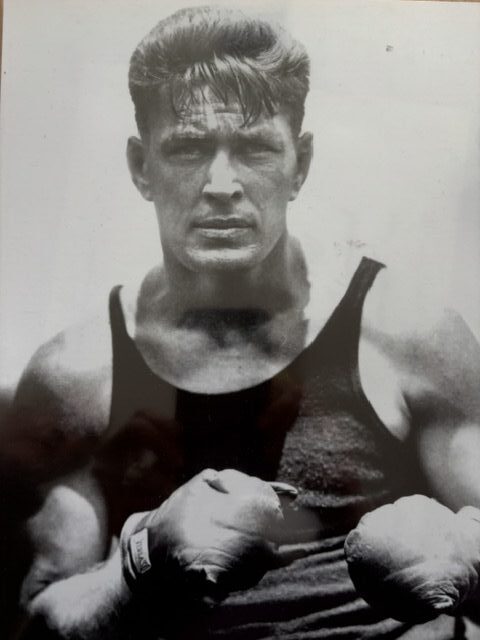
The signed photo above of the former World Heavyweight Champion (1926-1928) Gene Tunney hangs over my desk. It was given to me by a friend who is the a son of immigrants and who was a college boxing champion in his youth. He is a brilliant writer, psychiatrist, psychoanalyst, actor, singer – a man of immense talents and guts.
Tunney himself, one of seven children of Irish immigrants who grew up poor in lower Manhattan, was a great reader, a lover of Shakespeare and poetry. He didn’t graduate from high school. He was far from the typical boxer. He was a friend of the Dublin-born Nobel Prize winning playwright George Bernard Shaw.
Some readers might be repulsed by this photo. How, they may ask, can I celebrate the gruesome sport of boxing? What is it about this photograph that entrances me? I suggest they learn to read photographs and history.
What do you see in Tunney’s face? I see anguish and determination. No meanness. I see his fists raised in a defensive stance, which could turn offensive at the right moment.
It was taken in 1926, the year he defeated Jack Dempsey before more than 100,000 people to win the Heavyweight Championship. The following year, in a rematch, Tunney won again in Philadelphia before 120,757 fans, and for his career, he lost only one fight with sixty-eight victories. He was never knocked out and was knocked down just once in all his professional fights. He was recognized decades later by Muhammed Ali as one of the greatest boxers ever, one who was far ahead his time.
Coincidently, fifty years later, January 1976: Bob Dylan released “Hurricane,” his 8 minutes and 33 seconds long song about the wrongfully convicted boxer Ruben “Hurricane” Carter.
Rubin could take a man out with just one punch
But he never did like to talk about it all that much
It’s my work, he’d say, and I do it for pay
And when it’s over I’d just as soon go on my way
Up to some paradise
Where the trout streams flow and the air is nice
And ride a horse along the trail
But then they took him to the jailhouse
Where they try to turn a man into a mouse
Tunney was a very skilled thinking boxer. Shakespeare was a very talented thinking dramatist. Each in his own way stood on a stage and gave his audience vicarious thrills – glove fights, sword fights, wrestling, archery, It was long ago. Because he did his talking with his fists, Tunney is largely forgotten, but Shakespeare, the majestic songbird in words, is celebrated nearly 500 years since his birth. Each dealt with the violence that surrounded them, and it was great. Public executions were a popular entertainment in Shakespeare’s time and the massive slaughter of World War I had recently concluded when Tunney, who served in the U.S. Marines during the war, came to prominence.
Hamlet: “Sir, in my heart there was a kind of fighting that would not let me sleep.”
What are you fighting for? Or does the word “fight” discombobulate your carefully constructed equilibrium?
Like so many, he did not go to the war, the war came to him. The stage was everywhere. The spectacle surrounding, like being caught in a maze without an exit. The Drill Instructor said, “Men, you are lucky. You’ll get to go to ‘Nam and kill yourselves some Gooks.”
The Classical scholar Norman O. Brown so well describes our stage set: “Ancestral voices prophesying war; ancestral spirits in the danse macabre or war dance; Valhalla, ghostly warriors who kill each other and are reborn to fight again. All warfare is ghostly, every army an exercitus feralis (army of ghosts), every soldier a living corpse. The dead and the living who fought together at Marathon are indistinguishable.”
In the late 1960s, I was walking past Jack Dempsey’s restaurant on Broadway in New York City. It was raining and I hugged the store fronts. Dempsey quickly came out the door and we banged into each other. I was 23 years-old and he was 73. And despite my being an athlete and strong, Dempsey staggered me. I didn’t go down for the count since Dempsey grabbed my arm. We both laughed and the sight of his pugilistic-battered face struck me forcibly. In his youth out west, “The Manassa Mauler” as he was nicknamed, was a hobo, but as he once said, he was never a beggar. Wherever he went he took the most menial jobs to earn money. He said that from his early barroom brawls to his championships he only fought for money. When you have none and are hungry here in the USA particularly, boxing for an audience of ghouls can get you some. The poor are always driven by their lack in a predatory capitalist economy. Dempsey and Tunney are prime examples.
But, you say, Hamlet was a prince lacking nothing. He could have gone to the south of France and frolicked in the sea. But you forget the ghost. There are always ghosts.
Yours?
Sports don’t matter. Back in the 1920s boxing was enormously popular. It became an Olympic sport in Ancient Greece in 688 B.C. It’s therefore very old, which doesn’t make it good, just as a bit more than a century ago “the war to end all wars” was pure madness. I don’t celebrate violence. I oppose war and boxing and all the other violent sports that are once again in ascendency. I gave up on boxing in 1962 when Emile Griffith was allowed by the referee to batter Benny “Kid” Paret to death when Paret was defending his welterweight title.
But I can celebrate fighters like Tunney who carried himself honorably and was knocked down just once. Without fight, the world will defeat you. You will never be able to write a sentence that doesn’t choke in you throat. Nor actively to resist evil forces.
As the etymology of the word sport attests (from old French, desporter to divert, literally “to carry away”), sports are a diversion from something. Let’s call it “real life,” the place from where, as Ernest Hemingway so aptly put it in the title to his short story, “The Winner Takes Nothing.” Trophies of different sorts are handed out after golf tournaments, boxing matches, and at post-season dinners, but as the American philosopher William James said, “The skull will grin in at the banquet.”
Although sports can inspire us to think deeply, for most people, athletes and spectators alike, sports are a diversion from existential matters involving relationships, fears, politics, deep feelings, wars, life’s meaning, love and loss, death, etc. While surely fun, entertaining, and lucrative for professionals, sports are also absurd in the non-metaphysical sense since they involve movements through time and space toward unnecessary and fictitious goals where someone wins (lives) and someone losses (dies) in a game of unreality. In sports we play to overcome artificial and superfluous obstacles for physical joy, exercise, and money – and for deeper reasons we may not realize.
Albert Camus, after all, was a football goalie in his youth and once said that the football pitch was one of his two universities. He also said you can encounter the absurd on any street corner.
For months now, my wife and I have been making a necessary move from one abode to another. The distance between them is two-and-a-half blocks, but in real ways the distance is from here to eternity.
Week upon week we have been moving things from the home we have lived in for thirty-eight years to a much smaller condominium. And now I feel I am living in a condom with one of Kafka’s characters.
I dreaded it. I didn’t want to go and I didn’t want to arrive. This slow arrival – if that’s what it is – is an enigma.
Along the way I found myself lost. Utterly lost. Over the past three weeks I have had nine dramatic dreams about being lost and trying to find my way home. Gretel was no help; Hansel was worse. I went up to the Barge on the levy in New Rochelle and ran into Scott and Ernest, half-drunk and singing “American Pie” in Don McClean’s hometown. They were back on leave from Paris where they were fighting for the best book of the ’20s. They were throwing back daiquiris and asked me to join them. Soon we were sailing and Ernest read the opening to his new book about a boxer from Princeton named Robert Cohen. Scott read a few lines from his about how, at his father’s advice, he tended to reserve all judgments. I told them I wrote a book called At the Lost and Found and now I could only find the shimmer behind my eyes that made me dizzy and gave me a headache as I tried to find myself on a non-existent map.
Novalis: “Philosophy is really homesickness—the desire to be everywhere at home.”
Tunney was good, Ali was better, and Hurricane might have just been a song and dance . . . . ..
Tell it to me straight, will ya? I can’t find my way back. I’m lost. The world seems unreal and insane. A nun once boxed my ears and I lost my way then too.
But let’s at least sing with Ella to the tune of that wild cowboy poet, Cole Porter. Come on, let’s ride to the ridge where . . . .
Editor’s Note: At a moment when the once vaunted model of responsible journalism is overwhelmingly the play thing of self-serving billionaires and their corporate scribes, alternatives of integrity are desperately needed, and ScheerPost is one of them. Please support our independent journalism by contributing to our online donation platform, Network for Good, or send a check to our new PO Box. We can’t thank you enough, and promise to keep bringing you this kind of vital news.
You can also make a donation to our PayPal or subscribe to our Patreon.