
David Rieff and Steve Wasserman discuss the physicist’s Jewish identity, left-wing politics and loyalty to the country that stripped him of his security clearance.
A conversation with David Rieff and Steve Wasserman / New Lehrhaus
Robert Oppenheimer helped bring the atomic bomb into existence, then became a target of the government he served. In this conversation hosted by New Lehrhaus on October 25, 2026, biographer David Rieff joins publisher Steve Wasserman to explore Oppenheimer’s political awakening, his relationship to Jewish identity and the enduring questions his life raises about science, conscience and state power.
Drawing on his new book, Robert Oppenheimer: The Sphinx Without a Secret, Rieff considers the distance between the physicist’s public image and the elusive person behind it. The discussion also examines the government’s treatment of Oppenheimer as a warning to other scientists, and why the man associated with the bomb continues to haunt an age of technological and existential uncertainty.
Editor’s note: The following transcript has been formatted for readability. The speakers’ wording, repetitions, qualifications and existing bracketed clarifications have been retained. The introduction and historical clarifications are editorial additions. This version was prepared from the supplied text and has not been checked against a recording.
Robby Adler Peckerar: Good afternoon and welcome. I’m Robby Adler Peckerar, the executive director of New Lehrhaus, and I’m very glad you’re all here today for this conversation with David Rieff and Steve Wasserman, who have come together to discuss “Robert Oppenheimer: The Sphinx Without a Secret,” David Rieff’s new biography in Yale University Press’s Jewish Lives series. The book just came out this past week, and I want to give a few words of introduction before I turn this over to Steve, who will be leading our discussion with David.

David Rieff is a journalist and author based in New York. He has reported on the wars in Rwanda, Burundi, Congo, Liberia, Bosnia, and Kosovo. In the early 2000s he covered Afghanistan, Iraq, Israel and Palestine, and he has also written a great deal about Latin America, particularly Cuba, Mexico, and Argentina. His books include “Slaughterhouse: Bosnia and the Failure of the West”; “A Bed for the Night: Humanitarianism in Crisis”; “In Praise of Forgetting: Historical Memory and Its Ironies”; and “Desire and Fate,” about the contemporary culture wars. Since the full-scale Russian invasion, he has been concentrating on Ukraine. He teaches at the National University of Kyiv-Mohyla Academy in Kyiv, where he’ll be heading to teach again in just a couple of weeks.
I’d like to welcome Steve Wasserman, the publisher of Heyday, the independent nonprofit press founded here in Berkeley. A Cal graduate, he has been books editor at the LA Times, publisher of Hill and Wang and the Noonday Press at FSG, editorial director of Times Books at Random House, and editor at large for Yale University Press. He’s also the author of “Tell Me Something, Tell Me Anything, Even If It’s a Lie: A Memoir in Essays.”
Steve Wasserman: Many thanks to Robby and all his colleagues at New Lehrhaus for extending the invitation to be in conversation with David Rieff about his new book, “Robert Oppenheimer: The Sphinx Without a Secret.”
As everyone knows, Oppenheimer hasn’t exactly been an unexamined figure. There are at least a trio of fine biographical explorations, starting in 2004 with Jeremy Bernstein’s “Oppenheimer: Portrait of an Enigma,” which somewhat anticipates David Rieff’s own subtitle, The Sphinx Without a Secret. Then, rather famously now, thanks to the movie version, there is Kai Bird and the late Martin Sherwin’s remarkable tome on Oppenheimer. And then the following year, Ray Monk’s also excellent Oppenheimer biography.
Let’s get to the heart of the matter: Oppenheimer was notoriously one of the most deracinated Jews one could imagine striding the American stage, and during his lifetime he spoke and wrote very little about the nature of his Jewishness. Or, to put it another way: in what sense, other than the fact of his birth, was Robert Oppenheimer Jewish in a way that influenced his temperament, or his science, or what he did that makes us now regard him as a figure worthy of a biography?
David Rieff: Wow. Well, that’s an interesting beginning. First, let me echo Steve and thank the organizers for this chance. Steve and I go back a hundred thousand years, to the previous geological era. We practically grew up together, and we’ve certainly grown middle-aged and old together. It’s always a pleasure to talk with Steve because, among other things, you always get things you don’t expect, which is exactly the point of such dialogues.
To tell you the practical side of this, the first answer to that question is that the editors offered me several people, and I chose Oppenheimer for a lot of reasons. First, I thought I might actually have something to say, whereas with the other two who were offered to me, I thought it less likely that I could produce something good. Now, as to why they included him, unfortunately the people involved, Ileene Smith, the chief editor of the series, and Rebecca Keys at the Jewish Lives Foundation, aren’t here to speak for themselves. But my sense of the Yale Jewish Lives series is that they wanted to include pretty much anyone of note who was of Jewish origin, whatever their relation to their own Jewishness. There’s no question of that, though I’m speculating a bit.
It has to be said that three of the five scientists who have biographies in the Jewish Lives series were working on atomic bombs, the other two being Einstein himself, of course, and Admiral Hyman Rickover, who was not a physicist but an engineer, and who was really the father of the American nuclear navy. In fact, the Jewish Lives Foundation people are doing a sort of box set of all three of those books together, with different covers. I’ve read the Einstein, which is excellent. I’ve not read the Rickover.
I think you can make a case that the fact that Oppenheimer disliked being a Jew is what made him Jewish, in the sense that if he had really been totally indifferent to it, why would he have had any emotion regarding it? He wouldn’t have known this, because he would not have read the book (I’m not even sure it appeared before he died; he was born in 1904 and died in 1967), but Jean-Paul Sartre’s “Anti-Semite and Jew” really defines, I think, Oppenheimer’s relation to his own Jewishness. Sartre says that in many ways you’re a Jew if an anti-Semite calls you a Jew, and that you can’t escape it, whatever your feelings about it are. And I do think that applies to Oppenheimer.
He grew up, mind you, in an extremely deracinated German-Jewish family in New York. For those of you who know about this, and I’m sure there are a lot of people on this call who do, his father was a great follower of the Ethical Culture movement and of Rabbi Felix Adler, which was already sort of Reform Judaism on steroids. And Oppenheimer himself took the next step. There’s no evidence of any religious observance. Nonetheless, I think in these Sartrean terms it’s legitimate to say that he’s worth including in this series. Mind you, there are 81 of these books that have appeared so far, and there are probably other lives in the series whose subjects had a similar ambivalence or felt similar temptations to reject their Jewish identity.

He grew up, mind you, in an extremely deracinated German-Jewish family in New York. For those of you who know about this, and I’m sure there are a lot of people on this call who do, his father was a great follower of the Ethical Culture movement and of Rabbi Felix Adler, which was already sort of Reform Judaism on steroids.
I want to be clear, though: Oppenheimer didn’t reject it. He just didn’t talk about it once he went to university. That does change when Hitler comes to power. He is involved in raising money for refugee scientists to come to the United States and to Britain. This is before the war began in 1939, obviously. There are also two family members whom he manages to get out of Germany, and who ended up living their lives, as far as I know, in Berkeley, because that’s of course where he was teaching in the 1930s. He had a joint appointment in physics at Cal and then a second appointment at Caltech. But I think Cal was more important to him, because of Ernest Lawrence and the cyclotrons and the development of nuclear science that Lawrence was doing in the so-called Radiation Laboratory.
Steve Wasserman: Before we get to the 1930s, let’s dwell for a moment or two on the earlier life. He comes from this quite well-off family and does not have any particular religious formation. Then, correct me if I’m wrong, he’s admitted to Harvard, and he must have been one of the very few Jews at that time who gained entrance to a school that was notoriously allergic to Jews as students. So one wonders: aside from what he was learning, did his experience at Harvard have any discernible impact on his own sense of being Jewish that he ever spoke or wrote about or remarked upon, that you were able to discover in your research for this book?
David Rieff: No, he didn’t. Of course he would have [been aware of it]. Harvard had imposed a very stringent, very repressive regime of admissions for Jewish students. There had been many more Jewish students in the aughts of the last century, and then, in 1919 I believe, the new president of Harvard cracked down on Jewish admissions. So there were very few Jews at Harvard indeed. There was a famous chemist called Bernheim, who was a friend of Oppenheimer’s, and before that, I suppose, there was Bernard Berenson, the art connoisseur. Oppenheimer would have had to be aware of it, not least because there were all sorts of clubs and the like that Jews weren’t allowed into. He has to have seen it.
There’s an argument to be made that his thesis adviser, the senior person in physics at Harvard, a very distinguished man called Percy Bridgman, was something of an anti-Semite himself, of the genteel, Gentleman’s Agreement type. For example, when Oppenheimer graduated with his undergraduate degree, he was going to do his doctoral work in Europe, at Ernest Rutherford’s lab in the UK, actually. And Bridgman wrote to Rutherford saying, in effect, that Oppenheimer is a Jew but our kind of Jew: he’s a Jew, but he’s not Jewish. These are my words, obviously, not Bridgman’s.

And there’s absolutely no evidence, by the way, that Rutherford shared these anti-Semitic views. In fact, Rutherford was one of the people most active in the UK in the 1930s in getting German-Jewish refugee scientists out of Germany, or out of France and the other places west of Germany to which some of them had moved in the very last period. Rutherford, who was not Jewish and was from New Zealand, was enormously important in this effort. So this was Bridgman projecting onto Rutherford what Rutherford might think of Oppenheimer. Oppenheimer has to have been aware of it, but there’s no evidence to speak of that he paid much attention to it between the time he went to Harvard and the rise of Hitler.
Steve Wasserman: Indeed, there’s a suggestion, by Oppenheimer’s own admission, which I believe you quote in the book (it certainly was quoted in the testimony he was compelled to give after the war, when his security clearances came under scrutiny and were ultimately lifted, and this is fast-forwarding the story by a considerable number of years), that, if we’re to believe him, he did not read Time magazine or concern himself with current events. He was the very picture of what one would perhaps say now, perhaps too glibly, is someone somewhere on the spectrum: his mind was full of all kinds of ideas, scientific ones, but they had very little to do with the politics unfolding all around him, all around the world. Do you think he was being disingenuous, or was he describing his state of mind during those years when, for everyone who had eyes in their head, a calamity was looming?
David Rieff: Oh, I don’t know if it’s literally true that he was unaware of the Great Depression. That seems hard to believe. But it is true that he took no role in politics at all until the mid-1930s, when he would have been in his early thirties, around 32.
Steve Wasserman: He claims not even to have been aware of the 1929 stock market crash.
David Rieff: Well, he was extremely rich. One of the curious things about Oppenheimer is that he’s probably the richest physicist in the history of the world, as far as I know. His family made a lot of money in the garment business in New York. His father and his uncles were extremely successful businessmen, both importers and manufacturers. There was a huge art collection of Impressionist paintings, et cetera, et cetera. And Oppenheimer was probably also the scientist who has been most interested in the arts. It’s not that there aren’t other scientists interested in the arts, including Einstein, but with Oppenheimer one really feels that he could have been… He wanted to be a writer at one point, when he was at Harvard, and the arts were his other lifelong passion. He continued these interests after university.
There were some physicists who said, you know, this is distracting you from your work. The great English theoretical physicist and mathematician Paul Dirac, with whom he studied as a graduate student and later had as a colleague in several different contexts, told Oppenheimer at one point, when they were both students, that he had to stop reading so much poetry and do more physics. Now, I’m not sure that’s true at all. In fact, I’m pretty sure it’s not true. Look at Einstein. Dirac would never have said to Einstein, stop playing the violin all the time. But that was the view of him: someone interested in the arts, but politics, no.
Indeed, the politics start not in the context of what’s going on in Europe, the rise of Hitler. Rather, Oppenheimer becomes politically engaged at the time of the longshoremen’s strike in California.
Steve Wasserman: This is a good moment to stop and raise what is probably too little remembered, the 1934 San Francisco longshoremen’s strike. Give us a sense of the flavor of what a remarkable eruption of protest that was, and the ways in which it galvanized many people, not only in the San Francisco Bay Area.
David Rieff: Up and down the coast. People forget just how powerful the left was in the United States, and how important the trade union movement was as a militant organization, more on the model of European trade unionism than the sort of Cold War trade unionism of the post-1945 AFL-CIO, which was very much anti-communist. The longshoremen’s union in San Francisco was led by a man called Harry Bridges, who was a communist, and they were absolutely European-style left trade unionists. The strike was incredibly violent. At least two longshoremen were killed by the police, in Oakland I believe, at the port of Oakland. And it paralyzed trade up and down the West Coast, from Seattle all the way down to San Diego.
Oppenheimer had a very close relationship with his students and was, of course, constantly hearing about this from them. Many of them were great supporters of the longshoremen, and people were raising money in that period, including on the Cal campus, for the families of the strikers. So Oppenheimer’s first political activity that I’m aware of was participating in fundraisers for the strikers.
That politics deepened with the Spanish Civil War. He became very, very engaged in activism for the Spanish Republic, and that propelled him into a world of members of the Communist Party of the United States or fellow travelers of one kind or another. It was because of these connections that, even at the time, the powers that be, J. Edgar Hoover’s FBI, were very suspicious of Oppenheimer’s involvement in the nuclear program once the Manhattan Project, the project Franklin Roosevelt authorized to develop a nuclear bomb, got underway. Oppenheimer was excluded because of these engagements.
And the engagements were very deep. The most important erotic relationship of his life was with a woman called Jean Tatlock, who was a member of the party. She was studying psychoanalysis, or psychiatry, or whatever it was; I can’t remember now whether at Cal or at Stanford. I think at Cal. And she was a member of the party and a militant. He [wanted to marry] Tatlock, and Tatlock left him. He later married a woman called Kitty Puening, whose first husband had been a member of the Communist Party. She had followed him around to various places in the United States in his activism, and then he went off to Spain and was killed in combat as a member of one of the battalions of the International Brigades. His letters to her (he was called Joe Dallet) were published in the late 1930s by whatever the Communist Party press in the US was; I can’t remember what it was called.
So Oppenheimer was catapulted from no politics at all, if you like, to very left-wing politics. Now, it should be said that he went on doing his physics, and when the Molotov-Ribbentrop Pact, the pact between the USSR and Nazi Germany, was signed, Oppenheimer completely severed his… Oppenheimer began denouncing the party. But until then, whether he was a party member, which he always denied, or simply a fellow traveler (nobody knows for sure), he certainly moved in that world of communist activists, left trade union activists, people supporting the Spanish Republic, and so on. So the politics, curiously enough, come that way rather than through opposition to the rise of Hitler. Not that he wasn’t opposed to it, of course he was, but that wasn’t the way he was mobilized, in a sense.
Steve Wasserman: You usefully contrast Oppenheimer’s temperament and formation with Einstein’s. Einstein was, shall we say, more palpably and demonstratively connected to his Jewishness. What strikes one about Einstein is that he was somehow more comfortable linking his overall worldview to a sense of the predicament of a Jew in the twentieth century. Is that a fair characterization? And either way, how would you contrast the two men’s relationship to their Jewishness?
David Rieff: I don’t think Einstein had the slightest ambivalence about being Jewish. To the contrary, I think he felt it was an essential part of his being. But what kind of Jewishness is another question. He was not religious. He once said he believed in the God of Spinoza, which from a Jewish point of view is already heresy, literally speaking. And his relations with Zionism over the decades were very, very complicated. Chaim Weizmann wanted him to be the first president of Israel, and yet he had very complicated, very ambivalent views about Zionism and about Israel. I think he himself was aware that there was something slightly mysterious about why he was so attached to his own Judaism. But the way he formulated it was very obviously not a conventional formulation of what being Jewish meant.

Oppenheimer, as we were talking about earlier, obviously did not feel that tug. Jewish scientists who were his colleagues and friends noticed this, notably the great physicist Isidor Rabi, I. I. Rabi, who said that if Oppenheimer had spent more time on the Talmud and less time on the Bhagavad Gita, he would have been a better scientist. Whether that’s true or not, I rather doubt. But that was Rabi’s contention. And I don’t think that after the defeat of Nazi Germany Oppenheimer thought all that much about it. There’s no evidence that he did. As far as we know, the entity, the world, to which he was loyal was the US.
And when he lost his security clearances in these hearings, when he was stripped of his security clearances, the principal adviser to the United States government on nuclear affairs, specifically to the Atomic Energy Commission, but more broadly to both the Truman and Eisenhower administrations, though mostly Truman, Einstein said of Oppenheimer that he was in love with a woman who doesn’t love him: the United States of America. And there’s some truth to that. He didn’t really protest. Most people who watched him defend himself at these hearings were bowled over by his passivity. He wrote a letter in his defense and he testified, and all of this is available. There’s a volume of the transcripts edited by a man called Polenberg. I think it’s called The Fall of Robert… I can’t remember what it’s called. And it is striking how dispassionately he treated himself. I think you could say that he was, to some extent, a person simply estranged from himself.
But I don’t mean that as Rabi did, in terms of Jewishness. It’s just that he had a very fatalistic streak, which I think is one of the reasons the Bhagavad Gita interested him more than the Talmud. It resonated with him, particularly the demand the gods make on Prince Arjuna in the Bhagavad Gita: in effect, to do his duty and sacrifice himself, even though he knew what that would lead to.
Einstein is a fascinating figure, and unpacking Einstein… I mean, Einstein wasn’t a sphinx, and he had many secrets. In one way the two men couldn’t have been more different, and yet they’re constantly paired. They certainly were at the time. Both Oppenheimer and Einstein appeared on the covers of various newspapers and magazines as the reality of what had happened in the Manhattan Project came out to the American public. I don’t mean together; I mean separately, with each cover saying “father of the atomic bomb” and so on.
Einstein’s different. Einstein changed our relation to reality. He overthrew so much of what we’d assumed about the reality of the universe. You don’t compare Einstein to another physicist; you compare him to Isaac Newton, or Charles Darwin, or Galileo. Those are the only ones. But it’s also true that the atomic bomb would certainly not have been made in time had Oppenheimer not been the person running the lab that actually made the bombs. The Manhattan Project was enormous and included a number of other labs all over the United States. But everybody who worked on the bomb, including people who later became Oppenheimer’s enemies, like the physicist Edward Teller, the “father” of the American hydrogen bomb, said that what happened at Los Alamos, in the lab Oppenheimer ran, couldn’t have happened without him. And Teller was speaking as a mortal enemy. Teller really was a mortal enemy of Oppenheimer’s, although they’d once been friends.

Oppenheimer is the only physicist besides Einstein who is really a household name, even for people who are not very well educated in the sciences or don’t think about them. Niels Bohr, say, was second only to Einstein as a physicist in that period, and people have heard of Bohr, but you can’t imagine someone making an opera based on his life, as John Adams did, or a movie, as Christopher Nolan did not so long ago. The only two figures who would command that kind of popular [recognition], whom any educated person would in some sense have heard of, are Oppenheimer and Einstein. I say at the end of the book that even though Oppenheimer would not exactly be an easy fit for our times, he did bring the world the bomb, and that’s why.
Bird and Sherwin’s is a magnificent biography, although it’s less strong on the science. If you want the scientific Oppenheimer, you’re better off with Ray Monk. If you want the politics, you’re better off with Bird and Sherwin. But both books are magnificent. Indeed, my challenge was that since so many smart people had said so many smart things about Oppenheimer, I had to figure out how to write something that would make a contribution.
Steve Wasserman: Among those smart people who said some very smart things about Oppenheimer was your late father, Philip Rieff, in an essay published seventy-two years ago and included in a volume he edited called “On Intellectuals.” He ends this book by reprinting his examination of the case of Oppenheimer, and he makes several interesting points in that essay. First, he has the temerity to brand a whole class of what he calls elite scientists as fundamentally neurotic, or seen as fundamentally neurotic. I read this word neurotic, which was very much a fashionable word in 1954, in the afterglow of the Freudian psychoanalysis that was popular at that time.
But he also compares Oppenheimer’s defeat at the hands of the government, in the aftermath of his great achievement in assembling the atomic bomb at Los Alamos, when he’s hung out to dry in this public humiliation, in some respects to the Dreyfus case. He sees it as an inflection point in the way the state treats a growing cast of characters, scientists, who are very good at what they do. But there is a limit, and the state is now going to enforce that limit to prevent them from having policy implications for the direction of military strategy or other matters. There is going to be an effort to keep them at arm’s length. He seems to regard the predicament Oppenheimer faced as a critical moment, and it’s interesting to me that he reaches for a comparison to Dreyfus. What do you make of that analogy?
David Rieff: Of course, my father was interested in Freud; indeed, six years later, in 1960, he would write a biography of Freud called “Freud: The Mind of the Moralist.” And of course I’m aware of that essay. I dedicated the book, in fact, to my father’s memory. But look, I don’t think Oppenheimer was disciplined for anti-Semitic reasons, so I don’t think the parallel holds entirely.
Steve Wasserman: You think that neurotic, poetical types with an interest in culture and paintings on the wall are seen as largely Jewish?
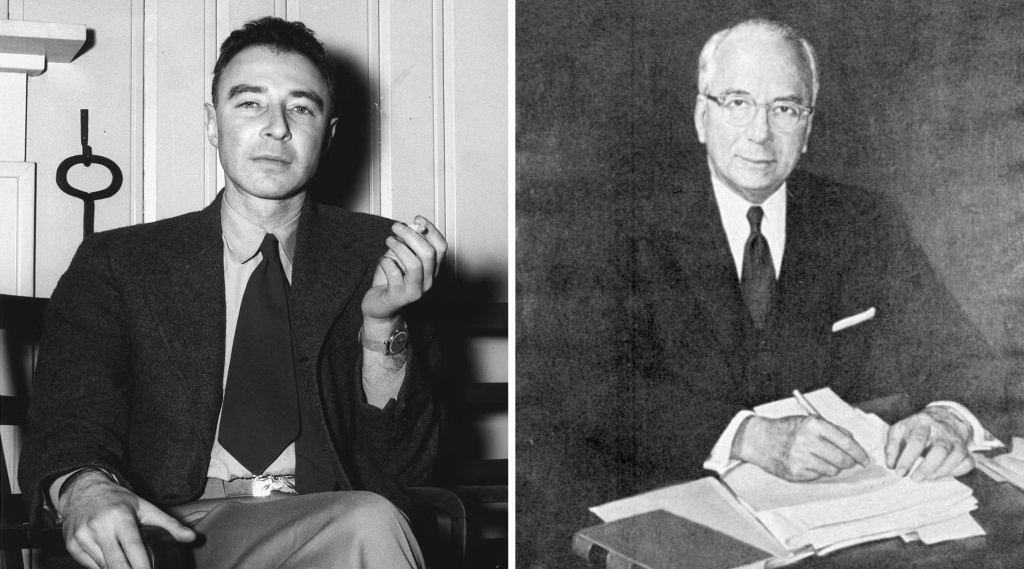
David Rieff: Well, the problem is that several of Oppenheimer’s greatest persecutors were also Jewish, notably Teller, whom I mentioned earlier, who was the person who denounced him, and Lewis Strauss, the senior government figure who really was Oppenheimer’s inquisitor. So there is an intra-Jewish quarrel in stripping him of his clearances, as well as some others who were affected by anti-Semitism. In that sense, can we make a parallel to Dreyfus? Absolutely. And there’s also the humiliation of someone who was an entirely loyal servant of his country, which Dreyfus by every account was, and Oppenheimer certainly was; hence the Einstein quote I offered up a few minutes ago.
But what I think my father got right in a very deep way is that this was the disciplining of scientists who, in a sense, had done whatever they pleased in the 1930s. What Oppenheimer represented symbolically was bringing them back into line, putting them in their place, reminding them, as I say, that they’re not above the state; to the contrary, they’re servants of the state.
A lot of them didn’t understand that, by the way, not just Oppenheimer, and not just the people who would later be persecuted for their views or their past entanglements. Many people who were not threatened in any way still understood very well what the message was in disciplining Oppenheimer, because you could, as it were, take down the most important nuclear physicist in the United States, except for Einstein.
But Einstein never wanted to be involved in anything to do with the US government and refused, even though he knew Justice Frankfurter very well, I think knew Brandeis before him, and had access to Franklin Roosevelt. He himself said it was simply inconceivable that he would ever have worked for the government as, in effect, a scientist-employee. Because I think, unlike most of the rest of them, Einstein understood the real relations of force, whereas I don’t think Oppenheimer and most of the others did.
Steve Wasserman: Do you think Oppenheimer was naive in some essential way, too trusting of the state? And had he been, let me put it very coarsely and reductively, more of a Jew, would it have acted as a prophylactic, shielding him from the kind of naiveté that made him more vulnerable when the government turned on him?
David Rieff: No, I think Oppenheimer was a stoic in a very deep way. That’s why I compare him, for those of you listening on this call, to Prince Arjuna in the Bhagavad Gita, who in a sense is told that whatever happens to him is his fate. I think Oppenheimer had very profoundly taken that lesson in. He never says this directly, but there’s quite a lot in his correspondence that suggests he thinks you must simply accept what befalls you. That is both a strength and, of course, a great weakness, depending on how you construe it. I think that was the appeal of Hinduism and the idea of karma to him. It resonated with him in a way that Jewishness just didn’t, leaving aside any neurotic complexes we might want to discern. (I’m not sure they exist, but you could certainly make a case for them.)
He read the Hindu scriptures, the Sanskrit scriptures, in the very early 1930s, because Oppenheimer was a language genius. There’s a famous story that he taught himself Dutch just to give a series of lectures at Leiden University. Later in life, when he recommended a paper to someone, the colleague said, “But it’s in Dutch,” and Oppenheimer replied, “Yes, but it’s very easy Dutch.” He spoke many, many languages. In 1930 or 1931, I think, there was a famous Sanskritist at Cal, whose name I’m blocking [Arthur W. Ryder], who basically taught Oppenheimer Sanskrit, and they read the Bhagavad Gita and the other scriptures together. I think Oppenheimer found something there that essentially coincided with his view of the world, which is that fate determines everything, which I suspect is why he didn’t defend himself.
But if he’d been more Jewish… to me, that’s like saying if an apple were an orange. That wasn’t the way he viewed the world. He was a Stoic. And it’s not clear he said all that much to anyone. That’s part of the reason Oppenheimer infuriated his friends. Here was Rabi, one of his great friends (they’d been American postdocs together in Germany in the 1920s; no, sorry, doctoral candidates), one of his closest friends, and he kept saying, if only Oppenheimer had been like this or like that.
On the one hand, people became obsessed with Oppenheimer. On the other hand, that obsession, I think, led them to judge him more harshly than they might judge someone they weren’t as obsessed with. He had that quality, particularly starting in the 1930s, when he came back to the United States and basically brought theoretical physics to Cal. Cal had had experimentalists, above all the great scientist Ernest Lawrence, but theoretical physics was really European. The quantum revolution, somewhere between 1920 and the end of the 1930s, is the last great scientific development in which American scientists played virtually no role. After that, there’s no great development in the sciences in which American scientists, or scientists working in the United States, don’t make central contributions. Whether that’ll be true fifty years on is another question. But the quantum revolution was Heisenberg, Bohr, Ehrenfest, et cetera, et cetera. They were all Europeans.
Steve Wasserman: It’s interesting to look at the arc of Oppenheimer’s brief life and the trajectory of his accomplishments. I think it’s fair to say he’s remembered less for any breakthrough in theoretical physics that he himself authored than for the combination of his curious charisma and his ability to manage this immense project, along with Leslie Groves, the general who supported him against a good deal of criticism of his, you know, pinko background or his fellow traveling, and defended him for the duration of the Manhattan Project and even afterward.
He is said to be a sphinx without a secret. In so many ways, it seems to me, this taciturn introvert kept a lot of secrets, and reading the tea leaves of his life proves something of a challenge: to tease out the salient factors that would mark him as palpably and self-consciously Jewish, whatever that might mean, and to figure out in what respect that temperament influenced his judgments or behavior. I’m put in mind of the great and famous line from the Bhagavad Gita that he quotes when the flash of the atomic test goes off. I want to believe, though I’m not sure I’m right, and I’m probably quite wrong, that the remark is the flicker of a bad conscience, even though of course he had enlisted himself in this dash to the finish line before Hitler and his henchmen got there first. And yet there’s something about this man, as you explain it: his acceptance of fate. Well, then, why does he apply himself so much, putting his thumb on the scale to hasten an outcome which, if left to its own devices, might very well have taken place, but at a later date, when a great deal might have been risked if it had not been pushed forward? How do you square or reckon with those competing elements in his makeup?
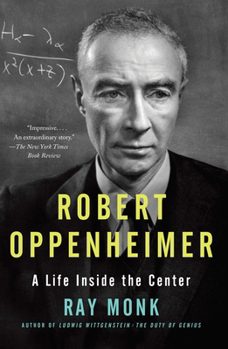
David Rieff: Well, let me do it backwards. I think Ray Monk, the subtitle of whose book is Inside the Center, is right to insist that Oppenheimer wanted to be, if you like, where the most important work in physics was being done. It’s not that he was without ambition, not at all. To the contrary, in this context he was tremendously ambitious.
Doubling back, it’s also true that he wrote important scientific papers, including one he wrote as a graduate student in Göttingen with his professor, Max Born, which is still used in physical calculations. It’s called the Born–Oppenheimer approximation. And just before the beginning of the Second World War, he did incredibly important work on what we would come to call black holes. It was really the first important paper theorizing black holes. But for some reason he never… Maybe he was too much of a generalist as a physicist; some people say that. The reason he could make Los Alamos work was that he knew quite a lot about everybody’s field, whereas that probably wouldn’t have been true of the division heads, who each had a specialty within the realm of nuclear physics and engineering. I think that explains something about why he never… I’m more tempted by that explanation.
He couldn’t focus narrowly in the same way that most of the Nobelists were able to do. What would have happened had the war not come, and he’d just gone on being a professor at Cal doing theoretical work? Who knows. He might have ended up doing some very particular thing that would have earned him a Nobel, but he fell just short of it. In fact, among scientists, when General Groves appointed him to Los Alamos, there was some unhappiness, because the other candidates, like Lawrence, all had Nobels already. Groves was kind of a monster, but he saw something. He realized that Oppenheimer was the person he wanted, and he was right.
As far as the Jewish stuff goes, I don’t think that would have changed very much. There’s an argument people have made that Oppenheimer was too subservient to authority. He went to study, I think, with Wolfgang Pauli in Zurich, when he was still a graduate student or a postdoc. I think it was Pauli. I may be mixing up the institution or the scientist, but it was some very senior figure of the quantum revolution with whom he’d gone to study briefly. And this person wrote to a colleague saying, I have to figure out a way to make Oppenheimer less subservient to authority, and I don’t quite know how to do this. Oppenheimer found that authority, I suppose, in the United States government. In that sense it is Prince Arjuna consenting to what’s being asked of him and being the good soldier, if you will, in every sense of the word. I think Oppenheimer had such a temperament, whatever his ethnicity. People have all kinds of temperaments, and his was melancholic and resigned. That’s why I use the word stoic, although you can push that too far, I think.
Steve Wasserman: As you thought deeply about Oppenheimer against the background of the unfolding events of much of the twentieth century, what, if anything, surprised you in thinking about this strange and remarkable figure?
David Rieff: Well, a couple of things. I was surprised by what I was talking about before. And I’ll come back to part of the question you asked, or the observation you made before, about guilt. I was surprised at how little evidence there was. He was a man who simply had his feelings under a kind of martial law. He just didn’t give anything away. But then the question becomes (hence my subtitle) was there anything to give away? Or had he decided, which is the case I make in the book, because of various traumatic events, a traumatic event in childhood, that the world was an unspeakable place, and one just had to get used to that and accept one’s fate?
There was something in his psyche even as an adolescent, when this thing happened. It was a kind of group rape, and I’m surprised more people haven’t talked about it in the biographies. It’s mentioned, of course, but I think it’s not given sufficient importance in the man Oppenheimer became.
I think he was the good soldier. And about guilt, that’s what’s so curious. My father talks about this, and my father’s essay on Oppenheimer is brilliant, but there’s another great one, written, oh gosh, thirty-five years later, by the great journalist and critic Murray Kempton. It was published in Esquire magazine in the early ’80s, I believe. Kempton basically says he was a man who, to his dying day, publicly defended the use of the bomb, and who became a great hero of the peace movement. Again, I’ve used this phrase before: people projected all kinds of things onto him. I wonder whether, if he hadn’t been gravely, underweight, and looked like some desert saint, if he’d been a sort of round-faced, cheerful fellow, people would necessarily have attributed the same conscience to him. I wonder. I’m not so sure. He defended it all the while.
Now, in fairness to Oppenheimer, he hoped, very much under Bohr’s influence, that nuclear weapons would be supervised by the United Nations, not by the United States. There was a plan, an American proposal for putting nuclear weapons under the control of the UN, and Oppenheimer was one of its principal architects. The plan was also supported by Dean Acheson. I think he was already secretary of state; he might have been undersecretary, I’m not sure. But in the end Truman turned this plan over to one of the rich people Truman relied on, the financier Bernard Baruch. And Baruch wanted a plan the Soviets could never have accepted: technically the UN would be given control, but in effect the US would have the real control. Oppenheimer understood perfectly well that that was an impossibility.

So had he known that nuclear weapons would remain in the hands of nations, whether he would still have been defending their development is very hard to say. But look, you also have to remember that it’s very easy for all of us to say those bombs shouldn’t have been dropped or should have been dropped on a barren atoll somewhere in the Pacific, where Japanese representatives could come and watch their fury. The truth is that most American planners believed, on the basis of the Battle of Iwo Jima, in which one-third of all the American participants were killed or wounded, that victory through an invasion of the home islands of Japan could only have been obtained at the cost of a million American casualties. We can all say they shouldn’t have done it, but boy, if you were a young soldier about to be sent to your virtually certain death, you might not have cared how the war ended. I don’t know what I think about that, by the way. I go back and forth on this.
But I often wonder, and I don’t think it’s a question that can be answered, whether [had they known] what the fate of nuclear weapons would be, they would have been as sure of themselves in aiding their development. I wonder. But it’s unknowable. The other question, of course, is that the bomb project was built because Leo Szilard convinced Einstein that the Germans would be able to build a bomb, and that there had to be an American bomb first. Einstein wrote a letter to Franklin Roosevelt to that effect, and soon after, Roosevelt authorized the Manhattan Project, which was enormous: in today’s dollars, billions and billions, all over the country, from Hanford, Oregon, to the University of Chicago, to Columbia University in New York. It was all over the country.
The thing is that by the time Oppenheimer and his colleagues pretty much had a bomb, it was clear that, A, the Germans were never going to get one, and B, Germany was about to be defeated. Remember, the test bomb was detonated after Germany had surrendered, at the Trinity test at Los Alamos. And nobody ever thought the Japanese were going to get a bomb. So the moral motivation people had had been complicated by the course of the war.
Steve Wasserman: This is probably a good time to open it up for questions from the people who have been kind enough to listen us for the last hour, prompted by the appearance of David Rieff’s new book, “Robert Oppenheimer: The Sphinx Without a Secret,” published by Yale University Press in their Jewish Lives series.
Robby Adler Peckerar: I have a question for you, David. One of the things I was thinking about while you were speaking is this recent wave of movies and books, not only about Oppenheimer but about that entire generation of physicists. I’m thinking of the novels of Benjamín Labatut, like The MANIAC and When We Cease to Understand the World. I think Labatut suggests that maybe these books are coming out now because these mid-century scientists, who dealt in the apocalypse in certain ways, tap into something about our collective terror right now about modern technology, about things like AI, things we’re building today. You write a lot about cultural memory, and I’m wondering what you think about this moment of reflection on these figures. Is that idea something you agree with? Or is this fascination with Oppenheimer more of a reckoning with the past? Or is it more of what Labatut is talking about today: our fears of a technology that is outgrowing its creators and may destroy all of us?
David Rieff: I certainly think fear of apocalypse plays a role in the interest in Oppenheimer. I’m a great fan of Labatut. I admire his work. There’s also a French writer called Jérôme Ferrari who has written a physics novel. And of course, there’s a play about Heisenberg and Bohr called Copenhagen, by a British playwright, [Michael Frayn]. And Dürrenmatt wrote one, called The Physicists, I believe. So it’s unquestionably the case that the fascination with that generation endures. There’s also an opera about Einstein, Einstein on the Beach. And there are very few scientists you could imagine having as many biographies written about them as Oppenheimer or Einstein. Einstein at least is a little more understandable.
I think the apocalyptic thinking of our time is very different from the apocalyptic thinking about the bomb. Today, I think, people, young people particularly, are mostly terrified of climate change. But if you look at science fiction films going back from the 1950s all the way through to the 1970s with the Planet of the Apes series, you have a post-nuclear world one way or another. I do think the notion that these bombs still could destroy the world [persists], even though younger generations, I think, are more worried by the Gulf Stream disappearing or the glaciers melting or the Amazon being destroyed. (I say this waiting with bated breath for the results of the Brazilian elections today.) I think that without the notion of the apocalyptic, Oppenheimer wouldn’t still fascinate people. I think that’s right.
Labatut is so fascinating because he really wants to talk about these scientists. There are not that many writers who do. There was a poet who wrote a cycle of poems about Richard Feynman. There has been some work, of course, on Alan Turing, but partly as a gay martyr, quite rightly so, by the way; it’s a correct interpretation of what happened to Turing. But certainly, the apocalypse and Oppenheimer, or the fear of the apocalypse and Oppenheimer, are inseparable. People were awfully scared. You’re too young, but Steve and I are old enough to remember bomb drills in elementary school, when you had sirens in the parks and civil defense posters pointing you to the shelters. That was America in the late ’50s and ’60s. The fear wasn’t just something people thought about in their homes. It was reinforced by the structures of everyday life.
Robby Adler Peckerar: We have a question in the chat from Diane, who says, “Rather than asking how he was Jewish, my question is whether he would have been or acted differently were he not Jewish.” She adds, “This is asked by a red diaper baby and a New Mexican who met people who saw the Trinity blast.”
David Rieff: Would he have acted the same way? I don’t know. Again, he was who he was, so in a sense I’m a little hesitant to say what he would have done if he’d been another person. If your aunt had wheels, she’d be a bus, et cetera. But I don’t see anything particularly Jewish in him, in the stereotypical sense. Maybe I’m just not alert to certain essential elements of being Jewish; that’s perfectly possible. But I don’t see anything. Again, I would say that he doesn’t seem to have thought very much about being Jewish except when there were anti-Semites around.
There’s a famous story. As a very young man, between high school and college, he went to New Mexico (these people were on a different planet) with his favorite English teacher from the Ethical Culture School in New York, whom Oppenheimer’s very rich family paid to take him there. He’d been very ill, and the idea was that he would recover. (Susan Sontag, my own mother, went to Arizona for the same reason in the 1930s.) And he said to this fellow, whose name was Smith, “Couldn’t I pretend to be your kid brother? Call myself Smith?” But there’s no evidence that after he became an adult and came into his own as a famous professor in the late 1920s and early 1930s, he was thinking in the same way.
Would he have acted differently? I’m skeptical of the idea that mid-century science is, if you like, Jewish science. I think that’s something people often say, but I wonder how true it is. What is true is that there were a wildly disproportionate number of Jews in physics in that period, just as there’s a disproportionate number of Asians today, East Asians and South Asians. But whether there was anything inherently Jewish in that, I don’t think so. Having said that, the question’s a good one. And I. I. Rabi, were he here instead of in the great beyond, would have said absolutely, he would have been a better scientist if he’d been more Jewish. That’s certainly what Rabi thought.
Nancy: Because Oppenheimer was in Berkeley in the ’30s, he would have been exposed to all the writings of the Jewish notables who knew what was happening in Germany before the rest of the US did. He was also wildly rich. Did he in fact try to save anyone, or do anything other than get the German scientists out?
David Rieff: He saved several members of his own family from Hanau, brought them over, and set them up in Berkeley, in fact, as far as I know. I’m not sure about that. But as I said before, I think he came to activism, including anti-fascist activism, if you will, much more in the context of the Spanish Civil War than of what was going on with Hitler. Although, as I say again, it really took the Molotov-Ribbentrop Pact for him to start disentangling himself from the American Communist Party. Was he familiar with the writers or the journalists who were telling the truth about… I don’t think he would have known them unless they were promulgated in communist circles, and I’m not knowledgeable enough about the history of the American Communist Party. Vivian Gornick would probably know the answer to that question. I’ve not found any evidence that he did. On the other hand, he did participate, as I say, in bringing several family members out, two or three, I can’t remember, and in contributing to various relief funds, and funds for Jewish scientists and their families to emigrate.
Robby Adler Peckerar: Another question in the chat is from someone who wants to hear about the resources you read or discovered that helped you write this biography, and which were the most eye-opening. Were there personal journals of Oppenheimer’s that you read, or does he mostly exist in other people’s writings and interpretations?
David Rieff: Well, not just writings, but transcripts and even videos of interviews. The late Martin Sherwin was the co-author, and really the principal author, of the Oppenheimer biography American Prometheus, which Nolan optioned and used as the basis for his film, with a few revolting inventions, particularly about Oppenheimer’s sex life, for which there’s absolutely no basis. But anyway, it’s a Hollywood biopic, so on a certain level it’s probably ridiculous to complain that a Hollywood biopic follows the rules of Hollywood biopics.
But what you have is an enormous archive of interviews, in various centers, with all of Oppenheimer’s colleagues in the scientific world, with this teacher Smith whom I mentioned before, and with people who were at school with Oppenheimer, and then of course all the memoirs of Los Alamos and the like. Oppenheimer was a prolific correspondent, but he didn’t even… When I talked about his stoicism before there’s a lot of correspondence with his younger brother, Frank, also a member of the Communist Party, with whom he was extremely close, and whom Groves also permitted to work at Los Alamos against J. Edgar Hoover’s entreaties. He tells his brother repeatedly, starting before the Nazis took power, that the next thirty years are going to be absolutely horrific. As Bette Davis says in All About Eve, buckle your seat belts, it’s going to be quite a ride, or whatever the quote is. Steve would know that better than I.
So I used mostly that, plus of course all the good work all these people have done, and then a lot of material on the history of American physics and on the quantum [revolution]. Because remember, Oppenheimer’s original idea, when he goes to study, is very consciously to come back to America and help found a proper school of American theoretical physics. As I said earlier, the US was very strong in experimental physics, at least thanks to Lawrence at Cal, but not strong in theoretical physics, and Oppenheimer felt that was his job. There were foundations that very much wanted this to happen. Many of the American graduate students sent to Europe, including Rabi, went on various foundation grants. Oppenheimer got one, but of course he didn’t need one, because he could pay for himself. They just gave him one, and he doesn’t seem to have refused it, but he certainly didn’t need it. He could have done anything he liked; he was a very rich man.
Bridget Marmion: David and Steve, it’s an honor for my path to intersect with yours again, decades after the years at 19 Union Square West at Farrar, Straus and Giroux. Regarding Oppenheimer not defending himself (I’ll put it in my words), I’d always, probably naively or stupidly, attributed it to two things. One, that he felt he had nothing to defend himself against; he’d done nothing wrong. And on the other hand, almost an arrogance, I’ll say. That’s just what I always attributed it to. But your explanations earlier, about stoicism and everything else, are much more interesting. Here’s my question: is there evidence that he later regretted the position he took, and wished he had defended himself more strongly or taken a different tack?
David Rieff: No, and that’s the most interesting thing. It’s nice to see you again, after all these years. No, there’s no evidence of that. What there is, is two sets of testimonies after he was stripped of his clearances. Most people said he was broken by it, that he never recovered from it, that he was existentially wounded by it. But then there’s a minority of people who worked with him (these are all his contemporaries; I’m not talking about later interpretations), people like the great British scientist (oh gosh, I’m blocking his name for a minute, it’ll come back to me) who worked with Oppenheimer and was much younger: Freeman Dyson. Dyson said he thought Oppenheimer, if anything, was relieved. Now, maybe that was Dyson projecting, but Dyson knew Oppenheimer extremely well.
And as for his failure to defend himself, whether out of arrogance: I do think there was an element of that. Stoicism, sure, but on some level, stoicism can be a form of arrogance. It isn’t always, but it can be. I think everyone was puzzled. André Malraux, watching these events from Paris, following the case and writing about it in the French press at the time, is constantly asking why this fellow doesn’t defend himself. I believe Oppenheimer thought, and I think correctly, that he had done nothing so wrong that it would merit losing the clearances. He admitted that he’d covered up certain contacts with communists and communist sympathizers. But no one, not even Groves, not even Strauss, said that he’d given any secrets away. There was a Soviet spy at Los Alamos called Klaus Fuchs who did give those secrets away, but that wasn’t on Oppenheimer. He wasn’t responsible for that, and no one accused him of it.

All I see is that he just chose not to defend himself. What combination of self-importance, arrogance, stoicism, and humility went into it, I really don’t know. What I do know is that there was a deep strain of conformism in Oppenheimer, and Einstein saw this. For all his avant-garde taste in the arts, and all his openness to the quantum and all the radical experimentation in physics of that period, he was very conventional in certain ways. When he was sort of rehabilitated in the last years before his death, he got a presidential medal from Lyndon Johnson, in 1963, right after the assassination, or later; I’m not sure which. I think it was ’63. It could have been ’64. Edward Teller came to shake his hand, and, much to his wife Kitty’s fury, Oppenheimer shook Teller’s hand, even though a decade earlier Teller had been one of the principal witnesses against him, one of the people who wanted his head on a pike and got it. Kitty Oppenheimer didn’t shake Teller’s hand. So in a sense she was, as it were, more loyal to Oppenheimer than he was to himself.
Steve Wasserman: Do you think that what you call his tendency toward a certain conformism might also, perhaps more precisely, be put this way: that he found himself betrayed by an assimilationist impulse?
David Rieff: Well, I don’t know. Maybe. I wouldn’t have said that. I think plenty of people who didn’t assimilate still wanted to conform. I don’t know that I think assimilation… Because, again, I’d give you the example of… a lot of people in front of these hearings didn’t fight back, whether because they felt it was hopeless, as several of the members of the so-called Hollywood Ten did. (Some made very big statements, but others just kept quiet.) You could also talk about Alger Hiss. The problem is that Alger Hiss was guilty, so his failure to defend himself was perhaps his only move.
But I think it has much more to do with Oppenheimer’s nature, and I don’t see it in terms of his relation to his Jewishness, unless you want to get very Freudian, or even Reichian, and say that people who repress things in themselves pay for it in other ways. Maybe that’s true, maybe it isn’t. I’ve never been able to make up my mind on that. But that would be the only way I could really see it, because he’s very consistent, Oppenheimer. As I said before, his subservience to authority… certainly plenty of self-identified Jews have been subservient to authority. There’s nothing either Jewish or non-Jewish in that, surely, in my view. And as I said, this subservience to authority goes back to his experiences [in Europe], to these scientists in Europe writing to each other slightly ruefully about why Oppenheimer can’t stand up for himself. But he was very confident in other ways.
I’ve always rather thought that he wanted very few things in life. He wanted to be a great scientist, and he wanted to be a major player on the scientific side of his country’s power and success. When he lost that, I don’t think he really knew how to fight back. His letter defending himself is not good. It’s true that he defended himself badly; as everybody said at the time, no one thought he did a good job of it. The people who hated him thought he didn’t defend himself because he was so obviously guilty. But there’s actually very little evidence for that. That’s why I think my father’s essay, Murray Kempton’s essay, are important.
And that’s where the Dreyfus example does work: it was decided to make an example of Oppenheimer. They could have picked someone else, but they picked, after all, the most senior person they could make these charges against. There was no one else in the nuclear establishment, including the Jews, with his record: he did have a history of being a fellow traveler; he may even have been a member of the party, who knows; he certainly kept links with people in the party long after he was supposed to have severed them; he was married to a person who had been a party member and had a brother who was a party member, et cetera, et cetera. It really was like going hunting and deciding you should shoot a cow. It really doesn’t take much skill. And the fix was in from the start. There was no question that he was going to lose, but he could have gone down swinging, and he chose not to.
Robby Adler Peckerar: Well, I think we’ve run out of time for this afternoon. I want to thank both David and Steve so much for this incredibly interesting conversation. Thank you for this fascinating and wonderful conversation about a really puzzling figure in history.
Explore the man behind the atomic age in David Rieff’s Robert Oppenheimer: The Sphinx Without a Secret. Published by Yale University Press in its Jewish Lives series, this biography examines the physicist’s private world, troubled childhood and complicated relationship with his Jewish identity. Learn more and find ordering information at Yale University Press.
Editor’s Note: At a moment when the once vaunted model of responsible journalism is overwhelmingly the play thing of self-serving billionaires and their corporate scribes, alternatives of integrity are desperately needed, and ScheerPost is one of them. Please support our independent journalism by contributing to our online donation platform, Network for Good, or send a check to our new PO Box. We can’t thank you enough, and promise to keep bringing you this kind of vital news.
You can also make a donation to our PayPal or subscribe to our Patreon.