
Kit Klarenberg and Wyatt Reed· The Grayzone
As public anger against the Nepalese government mounts after deadly landslides in Nepal, files show the country’s new prime minister and several of his colleagues came to power thanks in part to a covert program sponsored by the US government.
Eight months before a deadly landslide in Nepal claimed over 1,000 lives this September, the country’s new leaders emerged for the first time. It was December 2025, and a meeting had just been held in Kathmandu between the city’s rapper-turned-mayor, Balen Shah, and the head of the Rastriya Swatantra Party (RSP), Rabi Lamichhane. Having seized power after the bloody unrest which rocked Nepal just a few months prior, the pair immediately put forward a seven-point plan pledging to root out “corruption and poor governance,” and to replace it with “good governance, prosperity, and social justice.” Under its terms, Shah would serve as the Prime Minister of Nepal, and the RSP would govern alongside him.
But less than a year after promising to liberate the country from nepotism and oversee a nonpartisan technocratic administration, they’ve produced the opposite effect. Following the landslide, the influencer-led government is facing growing criticism at home and abroad over claims they refused outside offers of aid, seriously mismanaged rescue efforts, engaged in shameless self-promotion amid the misery, and demanded donations be channeled into accounts they oversee personally.
Now, leaked documents reviewed by The Grayzone reveal how both Shah and Lamichhane were groomed for power by the Consortium for Elections and Political Process Strengthening (CEPPS), an offshoot of a self-described CIA cutout funded by the US government: the National Endowment for Democracy (NED).
Since its foundation in 1983 by the Reagan administration, the NED has funded anti-government opposition groups in countries where Washington has sought regime change, earning a reputation as an “overt operator” doing the work the CIA used to do in the shadows. Its role in destabilizing governments in Nicaragua, Venezuela, Ukraine, and Haiti is well documented, and a point of pride for NED’s neoconservative backers.
As The Grayzone reported in 2025, the NED has also been active in Nepal, funding youth activists to undermine its now-deposed government. The new batch of leaked documents shows that NED-funded groups like CEPPS advanced the careers of numerous prominent figures involved in Nepal’s 2025 coup.
Many of these new, CEPPS-trained members of parliament are senior members of the RSP, which dominated the country’s most recent elections in March 2026.
Those elections were prompted by street protests which engulfed Nepalese cities in September 2025 and led to the resignation of the country’s elected government, then headed by Prime Minister K.P. Sharma Oli of the Communist Party of Nepal. Dozens died when peaceful demonstrations gave way to mass chaos, with buildings across Kathmandu set ablaze. As Nepal’s Parliament building burned, security cameras were disabled, water tanks emptied, documents burned and accelerants were used to intensify fires.
Days later, Oli was replaced by an interim leader chosen in an anonymous poll which registered fewer than 10,000 votes from Discord accounts.
Senior members of Nepal’s new NED-approved government, including premier Shah himself, have been implicated in the violence that took place during the unrest. The leaked documents show that the founder of the RSP and the founder of Hami Nepal – the primary NGO that led the demonstrations which unseated Oli’s administration – were identified by name as persons of interest to CEPPS.
However, an interim government commission ostensibly aimed at bringing those responsible for the violence to justice has declined to pursue the prominent figures named in the files.
Mainstream media touted the September insurrection as an organic burst of revolutionary fervor, orchestrated by members of Kathmandu’s disaffected, extremely online “Gen Z.” However, as The Grayzone revealed, the US government’s NED was already training young Nepalese how to orchestrate street-level havoc to further their partisan goals, spin out new political parties, and campaign for office.
The new batch of documents underscores how extensive and explicitly partisan the training was.
Drawn largely from a 2019 Annual Work Plan by CEPPS, the leaks show the US government provided $20 million to the International Republican Institute, a GOP-run wing of the NED – along with fellow NED assets the International Foundation for Electoral Systems and the National Democratic Institute – to manage a Nepalese project titled “Niti Sambad” (“Policy Dialogue”) from July 2017 to July 2022.

Niti Sambad’s activities and objectives complemented the youth radicalization programs concurrently run by IRI, whose political maneuvering in the Himalayan country is on full display in the files. Much like in Bangladesh, the supposedly organic “Gen Z” coup in Nepal was preceded by IRI efforts to coach locals on “how young leaders can drive political change through protest.”
“[Expanding] the reach of its youth leadership program” was a core component of Niti Sambad, according to a leaked CEPPS document outlining the organization’s priorities in Kathmandu over 2019 and 2020. Under its auspices, CEPPS partners were to “widely engage youth leaders from Nepali political parties,” while challenging “social traditions and the hierarchical nature of politics in Nepal” to facilitate further influence and representation for young, IRI-trained upstarts.

Listed among the “catalytic civic leaders” that CEPPS said it “will support” were four men who are now both senior members of RSP and top leaders in Nepal: party chairman Rabi Lamichhane, Prime Minister Balen Shah, Parliamentarian Sagar Dhakal, and Nepalese Home Minister Sudan Gurung.
As the death toll in Nepal continues to mount following the calamitous landslide, these figures have been subjected to widespread criticism for their lackluster response by ordinary Nepalis throughout the country.
Tunnel vision
In the days since thousands of people disappeared as millions of tons of ice, mud, and rock surged through Nepal’s Trishuli River valley on August 26, most of the public condemnation has focused on Prime Minister Shah himself. The discontent stems largely from allegations that Shah rejected much-needed international aid, and from his attempts to justify his government’s mismanagement in public appearances.
As rescue efforts floundered, critics say the government sat on its hands, declining to approve foreign assistance when it was needed most. Bhim Gautam, the chief executive officer of the Independent Power Producers Association of Nepal, told NPR that eventually he and his colleagues were forced to “pressure the government” to allow in rescue workers from China, India and Australia. “But it is so late now,” he added.
One political analyst consulted by the US outlet concluded that Nepal’s aid snub was a direct response to the notion that “China managed to gain a geopolitical foothold in the country” after it assisted Nepal during a deadly earthquake in 2015. Outraged that anti-China paranoia was seemingly dooming trapped Nepalis to death by suffocation under the earth, a prominent Instagram account involved in the 2025 overthrow of Nepal’s government demanded: “Please put your ultranationalism somewhere else and urge the government to accept whatever support we receive, from whichever country, right now.”
Western outlets and some Nepali commentators have sought to blame China for the landslide, claiming that Beijing withheld data that could have saved lives. But documents publicized by Reuters on August 30 showed that just 12 days before the disaster, China did indeed provide advanced warning to Nepal that “enhanced rainfall is likely across much of Nepal” and could cause “the potential for secondary and cascading hazards, including but not limited to landslides and flash floods.”
Shah also invited the ire of local Nepali government leaders and NGOs when he insisted that all donations be made exclusively through a portal controlled by his office in a supposed effort to prevent “possible financial fraud.”
In the time since, Shah has continued to ruffle feathers by insisting that the government is incapable of doing anything more to assist those trapped by the landslide. After he declared on September 3 that “no country has extensive expertise in dealing with this kind of situation” and that “there is no technology available anywhere that can be used immediately,” the pushback from experts was overwhelming.
“The prime minister was completely wrong,” replied one engineer currently serving on the tunnel rescue operation. “The process of rescuing people from a mud-filled tunnel is the same around the world, and both the expertise and technology exist.”
The response from another specialist was even more damning.
Accusing the Prime Minister of “irresponsible” rhetoric, the director of the Nepal Engineers’ Association, Subash Chandra Baral, said the situation was clear: the government “did not know how to carry out the rescue, they failed to prepare, they made mistakes and now they are shifting the blame to others.”
It’s not just the prime minister who’s been facing the public’s wrath, however. Home Minister Sudan Gurung, who’s made headlines in Nepal for participating firsthand in the ongoing tunnel rescue, is also under mounting scrutiny. Though some appreciated the symbolism of his personal involvement on the project, critics were quick to point out that he’s responsible for directing a whole-of-government response, not micro-managing individual operations. As Nepalese daily The Statesman put it, “Sudan Gurung is Nepal’s Home Minister, not a tunnel rescuer.”
Another headline in Nepal’s OnlineKhabar outlet posed the question: “When the Home Minister becomes a rescuer, who leads the disaster response?”
Gurung also raised eyebrows when he announced on his Instagram page that he was soliciting donations for his own personal NGO, “Hami Nepal” – even as the government in which he served was explicitly demanding that funds be directed to the state-led collection fund and not to nongovernmental entities. The post was quietly removed from social media shortly thereafter.
MP Sagar Dhakal has also come under fire for his conduct amid the horrifying natural disaster. After critics on social media lambasted Dhakal for touring the disaster site in a helicopter while rescue efforts stalled below, the parliamentarian was one of four RSP members named by local media who were accused by Nepalis of treating the scene of destruction like a tourist destination.
Public consternation over the endless stream of selfies published by figures like Dhakal grew so intense that it forced RSP chair Rabi Lamichhane to formally demand his colleagues stop engaging in “disaster tourism,” pleading with party members in a private discussion that an RSP spokesman later summarized as follows: “Our job is to provide relief to affected communities, not to become a burden on them.”

But Lamichhane himself had also become an object of public derision due to his perceived disinterest. It wasn’t until four days after the catastrophe that he finally began discussions with the local leaders overseeing the affected areas.
To understand how a government that spends so much of its time on social media could end up so out of touch with its constituents, it’s important to examine the history of the party itself.
Nepalese governing party RSP rife with NED assets
The RSP itself was founded in 2022, when Rabi Lamichhane entered politics following a lengthy spell as a well-known, Guinness-World-Record-breaking TV journalist. Lamichhane, who remains RSP’s president today, launched the party at a moment that coincides precisely with the end of Niti Sambad’s initial period of funding.
Lamichhane quickly became Nepal’s deputy prime minister and nearly as quickly was forced to resign and leave government when it was revealed that he’d failed to renounce his US citizenship, which is illegal under Nepal’s constitution.
But his party found new life after the overthrow of the Oli government, when it joined forces with the shady protest movement’s most visible faces.
Chief among them was Shah, an engineer and socially conscious rapper who rocketed to national prominence and became mayor of Kathmandu in 2022, just three years after he was named in the CEPPS files. As his city burned in September 2025, Shah took to social media to declare his solidarity with the protesters. Critics say he went even farther, with pro-government students claiming he deliberately prevented city firetrucks from putting out fires at federal buildings. When Shah joined the RSP shortly after the coup – elevating the party into a “political behemoth,” The Kathmandu Post later wrote – he immediately became RSP’s candidate for the country’s top office.
CEPPS’ support for Shah marks the fifth known instance of NED boosting rappers in an effort to topple a supposedly hostile regime. Previous funding recipients included hip-hop groups in Venezuela and Senegal, and – as revealed by The Grayzone – anti-communist emcees in Cuba and a protest rapper in Bangladesh.
Thirty-five years old and enormously popular with young Nepalis, Shah was elected to parliament in March and immediately appointed prime minister.
Another top member of the new political elite, Sudan Gurung, found his way to the political scene in 2020 when he founded his NGO, Hami Nepal. After years of scarce political activism, the group became central in organizing the September 2025 unrest that ousted Oli’s government. And though Hami Nepal’s Discord server had bristled with messages expressing violent intent in the days leading up to the protests, the NGOs leading the protest would go on to distance themselves from the destruction unleashed in the country after the fact.
After Oli’s overthrow was achieved, Hami Nepal subsequently selected individuals to serve in the country’s interim government, in conjunction with Kathmandu’s powerful military.
Gurung joined RSP in January, shortly after Shah, and was likewise elected to parliament for the first time in March.
NED identifies young ‘potential emerging leaders’ to act as ‘agents of change’
As part of its mission to use social engineering to induce regime change across the world, NED has long sought to target those it views as a country’s most vulnerable groups. In the case of Nepal, this meant going after the country’s youth, disabled population, and minorities.
In a section outlining NED’s efforts to “Create, Support, and Build the Capacity of the Next Generation Leaders in Parliament,” the document’s authors noted that “CEPPS/NDI has identified potential emerging leaders across the political spectrum who could also act as agents of change in parliament.” The politicians handpicked by the US would enjoy the generous backing of CEPPS as it worked to “create, support, and build the capacity of the next generation leaders in parliament.”
Those “potential emerging leaders” appeared to include Shah, Gurung, Lamichhane, and Dhakal, who were specifically named as “catalytic civil leaders” that CEPPS planned to assist in a section describing its youth outreach efforts.
Washington’s work in Nepal would be spearheaded by a youth policy forum meant to connect dozens of NED-approved potential future leaders from select demographic groups with representatives of prominent local Western-funded civil society organizations.
NED planned to “engage with a group of 25 to 30 young and emerging MPs… to create the Generation Next Parliamentary Forum.” This body would represent Nepal’s “diversity in terms of gender, region and ethnicity to harness their enthusiasm and channel their energy towards their own leadership capacity as change makers within the political machinery of the parliament.”
CEPPS and NDI intended to assist chosen future leaders extensively, teaching them how to market themselves to specific audiences. The US government funding mechanisms promised ambitious plans to ramp up their “public exposure” and “provide them with a series of trainings on social media, public relations, public speaking and overall leadership development.”
The idea was to “build a community of young parliamentarians who act as agents of change on an everyday basis both externally and within their roles as parliamentarians,” the document explained. “This would also create a community of friendship and solidarity across the group and bolster young parliamentarians,” which would work to enact what CEPPS called “progressive and democratic agendas.”

Indignation about youth unemployment was central to Kathmandu’s September 2025 coup – though after the shift in power, joblessness among young Nepalis remains virtually unchanged nearly a year later.
But the country’s youth were far from the only disenfranchised group to be targeted.
NED seeks to exploit female, disabled, and ethnic minority Nepalis
Another priority listed in the leaked CEPPS files was enabling “increased access to the political system for ethnic minorities, including Dalits, Janajatis, Muslims, and Madheshis” as a core objective in Nepal. The organization planned “to conduct outreach to ethnic minorities and will conduct targeted civic and voter education programs using materials in a variety of ethnic languages.” Meanwhile, CEPPS partners would “connect with minority representatives” to “carry out targeted work.”

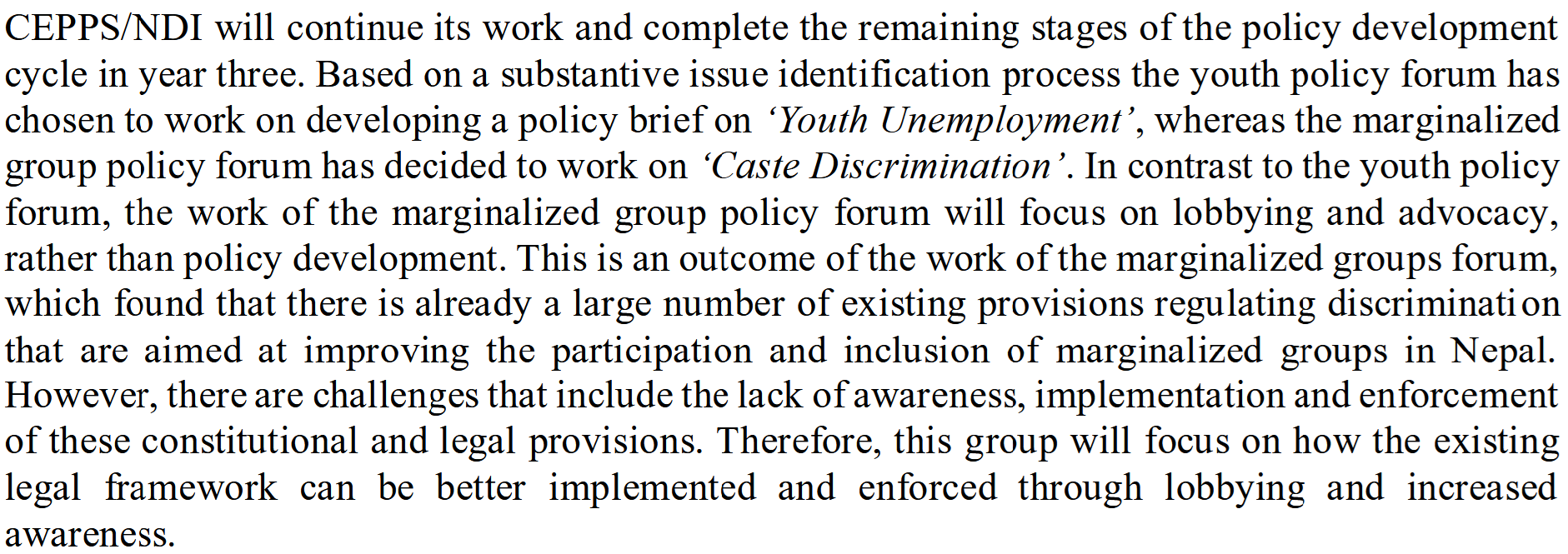
As a historically marginalized community in Nepal, NED and CEPPS appeared to view Madheshis as ideal footsoldiers for carrying out regime change. A dedicated “marginalized groups forum,” mirroring CEPPS’ youth body, was set up to exploit “caste discrimination” as a wedge political issue.
Disabled Nepalis were also of interest, with CEPPS seeking to increase their access “to the political process through civic education and advocacy.” Engagement with women – “particularly in leadership and decision-making positions” – was similarly encouraged.
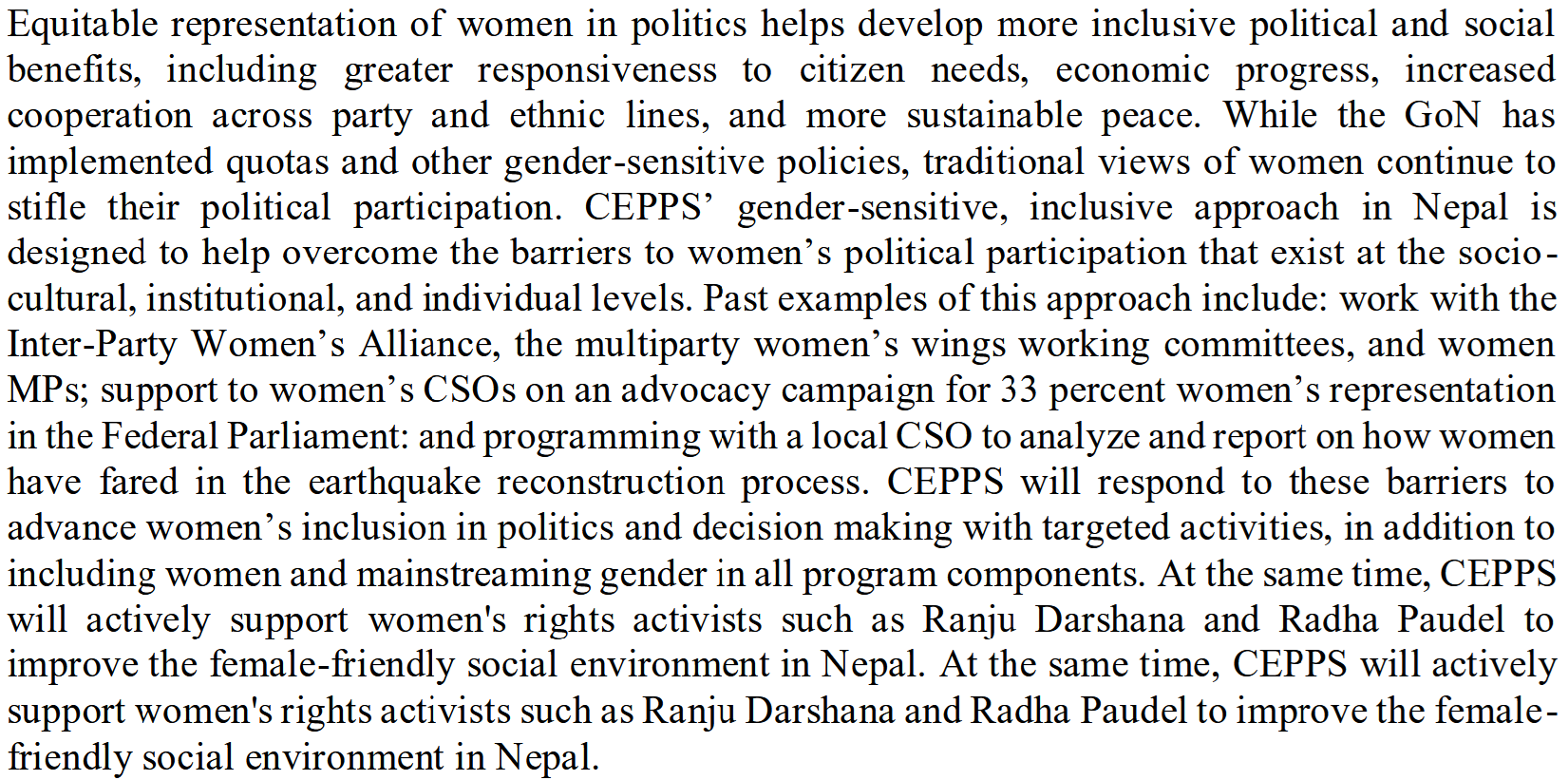
Beyond collaborating with Nepali parliament’s Inter-Party Women’s Alliance and campaigning for the legislature to be made up of at least one-third women, CEPPS also offered a “training course on leadership and advocacy skills” as well as “technical sessions on Nepal’s federal system, elections and political processes.”
In an effort to “improve the female-friendly social environment in Nepal,” CEPPS pledged to “actively support women’s rights activists such as Ranju Darshana.” Like clockwork, Darshana was elected to parliament for the first time in March, as a Rastriya Swatantra Party MP.
NED analyzed Nepalis’ ‘behaviors and thought processes’ to craft messaging
Not content with merely seeking to select Nepal’s future leaders, NED/CEPPS complemented their political machinations with public opinion polls that were used to gauge the success of their efforts.
CEPPS would conduct both “coordinated national public opinion surveys” and “mini public opinion research” for its preferred political parties, the document promised. Its polls and focus groups, the US government cutout said, were a “valuable tool” for understanding “what citizens think, and [giving] insight into citizens’ behaviors and thought processes.”

The results informed the organization’s activities in the country, with “national surveys” used to “develop standardized questions that cover national policy issues to be answered by parliamentary candidates” during election debates, among other applications. As a result, Nepalese lawmakers, activists and would-be MPs were well-equipped to disseminate popular messaging resonating with specific target audiences, while ultimately all reading from a Washington-approved script. Average citizens would know nothing of CEPPS’ role.
Whitewash commission exonerates NED coup perpetrators
Nepal’s new government formally assumed office on March 27. Immediately after Shah took power, however, the same mainstream media apparatus that had cheered on the dissident rapper and his RSP abruptly began to take notice of a potentially major scandal implicating top members of the party, including the prime minister himself.
In the six months it led the country, Kathmandu’s unelected, military-installed interim government operated a formal commission to investigate the circumstances of the violent September 2025 coup. The commission’s report has not been publicly released by Shah, but leaked copies were received by major news outlets. Per the New York Times, the leaked report demanded criminal investigations into many of the ousted government’s leaders – including former Prime Minister Oli, who was arrested in March on charges of negligence for allegedly having allowed the deaths of protesters. The commission also interviewed officials of the new government, including Shah, about their potential complicity in serious crimes committed by the protesters.
Even as mainstream Western outlets are beginning to acknowledge the attacks that set Kathmandu ablaze were “coordinated,” investigators have so far declined to pursue the country’s new leaders. Though many – like Gurung and his Hami Nepal NGO – were intimately linked to the civil society and political organizations that orchestrated the tumult, Shah and his fellow RSP members are so far facing no blame and no criminal investigations.
This raises obvious questions about whether the report’s findings were influenced by Nepal’s current government. At the very least, it appears numerous witnesses lied to the commission. Shah, Kathmandu’s mayor at the time of the coup, claimed fire engines had been promptly dispatched to extinguish fires set by protesters. According to the suppressed report, however, the vehicles did not arrive quickly. In another curious twist, none of the municipal government buildings under Shah’s effective control in Kathmandu were damaged during the unrest.
Moreover, Nepal’s politically influential army, likewise conspicuously not targeted by protesters, responded very slowly to attacks on a government compound where fire damage was most severe, despite having a barracks on-site. There were also no professional investigations of any crime scenes until many weeks later, when evidence would have become severely degraded.
According to mainstream reporting, RSP founder and longtime NED asset Rabi Lamichhane is also a key “figure of contention” in the report due to his past legal troubles. His leadership of the party raises major questions about RSP’s anti-corruption platform.
Lamichhane was jailed in April 2025 as he was being investigated for numerous serious crimes, including fraud. He was freed during the September 2025 anti-government protests by an angry mob of several thousand of his supporters, who stormed his prison and forced its warden to sign a document granting Lamichhane’s release. That same day, an RSP district leader appeared in a video celebrating the torching of the headquarters of Kantipur, the local media group that exposed his citizenship problems and ruined his first stint in government.
Lamichhane has never commented publicly on the arson attack on Kantipur, which a commission investigator had previously declared was “obviously” linked to RSP. But the many credible links to violence would represent potentially powerful kompromat to ensure Kathmandu’s new leaders will be faithful servants to the US empire – or risk prosecution themselves.
The China Syndrome
Beyond the many references to how its trained pro-American cadres might serve US interests, the leaked files also reveal a preoccupation with subverting China’s regional influence. It’s unclear how effective this anti-China campaign has been, but it may have stymied precisely the kind of dialogue that could have improved the response to the recent landslide.
A separate leaked CEPPS document promised the organization would be leading a “coordinated and integrated network-wide initiative” on what it called “the negative impacts of China abroad on governance, business and human rights, surveillance technology, environmental abuses and repression of ethnic minorities.”
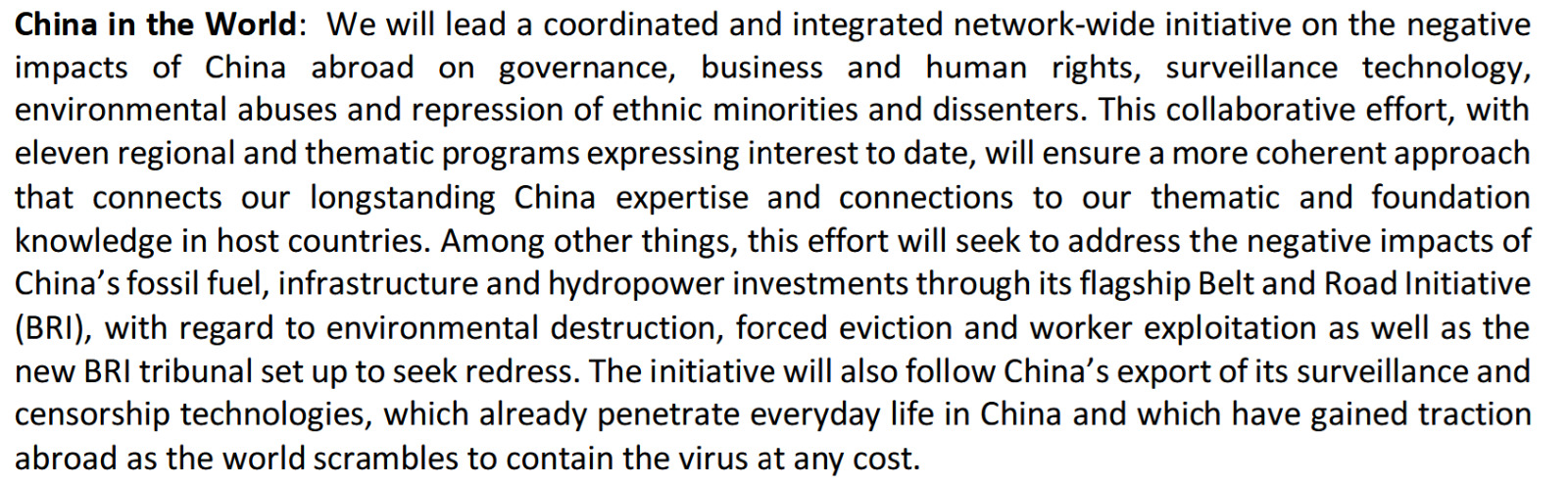
Central to the initiative was highlighting the supposed “negative impacts of China’s fossil fuel, infrastructure, and hydropower investments” made as part of Beijing’s Belt and Road Initiative (BRI), with CEPPS going as far as advocating the creation of a “BRI tribunal… to seek redress” for the Chinese development program’s alleged misdeeds.
The 2019 CEPPS report reiterated that its work in Nepal was being conducted “in line with the objectives of [Washington’s] Indo-Pacific Strategy” – a strategy that consists largely of encircling Beijing with pliable governments and US military installations.

If so, Washington may be facing a tougher battle than expected. In a statement published September 2, a significant proportion of civil society actors that supported the “Gen Z revolution” publicly criticized the government’s handling of ongoing rescue operations for the first time, while pushing back on anti-China sentiment. Bearing the signatures of 35 public figures – including at least 3 prominent backers of the 2025 unrest that brought the current administration to power – the letter blasted the federal government for failing to “demonstrate [a] coordinated and responsible role in the search, rescue and relief distribution” amid the disaster.
According to regional outlets, in addition to demanding financial transparency regarding funds and materials donated to the prime minister’s aid portal, “the activists also called for stronger cooperation with China on early-warning systems.”
Read The Grayzone’s December 10, 2025 report, “US regime change front funded Nepalese youth revolutionaries, leaks reveal.”
Editor’s Note: At a moment when the once vaunted model of responsible journalism is overwhelmingly the play thing of self-serving billionaires and their corporate scribes, alternatives of integrity are desperately needed, and ScheerPost is one of them. Please support our independent journalism by contributing to our online donation platform, Network for Good, or send a check to our new PO Box. We can’t thank you enough, and promise to keep bringing you this kind of vital news.
You can also make a donation to our PayPal or subscribe to our Patreon.