

This is a painting by Peter Carr titled, Now That We are Here
Used courtesy of Andrew Tonkovich’s Collection.

Used courtesy of Andrew Tonkovich’s Collection.
Jim Mamer ScheerPost
You can have democracy or you can have great wealth concentrated in the hands of a few, but you cannot have both.
Ralph Nader Quoting Supreme Court Justice Louis Brandeis
June 25, 2000
Democracy, We Hardly Knew Ye
In 1946, in Politics and the English Language, George Orwell announced that the English language was in a bad way. The major problem was the habitual use of words that are meaningless to both readers and listeners. Eighty years later, I can think of no better way to describe the current problem we have in successfully communicating anything about history, politics or democracy.
When he cited examples of “meaningless” words, he included the likes of capitalism, democracy, freedom and patriotism. Two qualities, Orwell continued, are common in creating this meaninglessness. “The first is staleness of imagery; the other is lack of precision.”
Staleness of imagery relies on clichés and outdated references. And those stale clichés remain common 80 years after he wrote the essay. Examples are easy to find. Soon after Democratic Socialist Zohran Mamdani became mayor of New York City, right wing media figure Laura Ingraham warned her audience “not to be fooled by smiling socialists who rule like Soviet tyrants.”
At the same moment, the New York Post after-election cover depicted a fabricated image of the new mayor holding aloft the Soviet Union’s hammer and sickle symbol. It sold out on newsstands by noon.
When words like “democracy” are used without clear definitions, readers and listeners will often assume that they understood what was said. Orwell described the power of this type of assumed understanding: “… not only is there no agreed upon definition, but the attempt to make one is resisted from all sides. It is almost universally felt that when we call a country democratic, we are praising it: consequently, the defenders of every kind of regime claim that it is a democracy.”
While it is easy for most Americans to believe that North Korea, also known as the Democratic People’s Republic of Korea, is not democratic, it is far more difficult for these same Americans to imagine that the United States might, like North Korea, not be democratic. Why? Perhaps because they want the United States to be a democracy, after all, as Orwell wrote: “when we call a country democratic, we are praising it.”
When Do Americans Learn That the U.S. is a Democracy?
I was first told that the United States was a democracy in grammar school. I had no idea what it meant, so I asked (more than once). The most memorable responses were that democracy meant “freedom” or that democracy meant “adults could vote to choose their leaders.” That’s about as far as the explanations went.
Throughout high school I remember being a reluctant, but still inquisitive, student. I knew I didn’t understand a lot of things, including all the words listed by Orwell, but school didn’t seem the best place to learn what I wanted to learn. So, I admit to skipping school multiple times to spend a day alone in a library, or sometimes, on a beach.
In high school, when I took the required classes in American history and government, I anticipated democracy would be a substantial part of the class. It was not. When it was mentioned, it was barely defined. Usually as “adults get to vote.”
Years later, as a teacher of both history and government, while reading student work, I saw real evidence that simply assuming students understood complex terms doesn’t work. Misunderstanding was making analysis difficult, sometimes impossible. They needed more practical definitions and real-life examples. That would take time.
“Democracy is a process, not a static condition. It is becoming, rather than being. It can easily be lost, but never is fully won. Its essence is eternal struggle.”
Federal Judge William H. Hastie
Defining Democracy by Identifying its Major Characteristics
In the sum total of data in the global datasphere, there is likely to be an endless number of lists explaining the “most important” characteristics of democracy. I actually found a listing of 100 characteristics, but I could not finish reading it because there was way too much overlap. I settled on a list of those that seemed most necessary. And even they overlap. If you don’t agree with my chosen characteristics, longer lists are easily available.
In what follows I will describe each characteristic separately and I will include factors that might render a characteristic ineffective. They are in no particular order.
A Democracy Must Conduct Regular Elections; Majority Rules Must Be Limited By Minority Rights
In general, all citizens choose their leaders through open, competitive and meaningful voting processes. That is to ensure that the government derives its authority from the consent of the governed. Some Americans obviously disagree and many believe, like the current Supreme Court, that there is no significant difference between “the governed” and “the donors.”
Some seem to feel stricter controls should be imposed because they feel, without evidence, that there is a lot of cheating going on. President Trump, for example, has signed two executive orders meant to restrict participation in the voting process. One is aimed at new registration requirements for voters, and the other is an attempt to severely limit voting by mail. At this point, both have been blocked by the courts, but the President continues to do everything possible to restrict mail-in ballots.
President Trump’s attempt to delegitimatize the democratic process is working. A new report from the Stockholm-based International Institute for Democracy and Electoral Assistance said their researchers have observed a global pattern of democratic decline. They have documented, “Severe drops in scores that measure freedom of expression, freedom of the press, credible elections, [and an] effective parliament.”
The organization’s annual Global State of Democracy report, tracks democratic performance across 174 countries and draws on data going back to 1975. Dr. Seema Shah says one country stood out for how far its democracy has declined. “The clearest example, unfortunately, is the United States.”
According to the report, in 2025, “President Donald Trump quickly amassed power in the executive branch and wielded it to further a narrow set of personal goals and pursue retaliation against perceived enemies. … The results have been far-reaching, undermining the rule of law domestically and internationally and testing long-standing alliances and multilateral cooperation.”
When the President was asked by Liz Landers of PBS if he might dispatch the National Guard or ICE agents to voting sites, Trump refused to rule it out, despite the fact that sending troops to polling places is illegal. Remember however that his refusal to answer the question is also a way to spread confusion and to limit the number of voters.
One of the most significant limitations on a “competitive and meaningful voting process” is the rapidly increasing role of oligarchs and their money in elections. I will outline that at the end of the section below.
Candidates Must Run on An Equal Playing Field
This means that candidates compete with more or less equal resources, and it assumes that whoever is elected will represent the people that elected them, not the donors that paid for the campaigns.
This has been summarized by the phrase “one person, one vote,” a touchstone of American constitutional law, which is supposed to help determine how electoral districts are drawn across states and at the federal level. That idea is rooted in the Equal Protection Clause and holds that each citizen’s vote should carry roughly equal weight.
Unfortunately, an equal playing field seemed possible only as long as campaign expenditure caps remained in place. Again, some disagree believing that there is no difference between “the governed” and “the donors,” but my opinion is that spending caps need to be restored. At a minimum we could go back to the Federal Election Campaign Act of 1971, but since those limits were placed only on candidates for federal office, it would be necessary to place similar limits on all candidates.
The idea that candidates run with approximately equal resources began to break down in 1976 with Buckley v. Valeo. The fundamental question before the court was whether the limits placed on electoral expenditures by the Federal Election Campaign Act violate the First Amendment’s freedom of speech and association clauses? The answer, unfortunately, was mixed.
The first part of the decision held that restrictions on individual contributions to political campaigns and candidates did not violate the First Amendment. But the second part held that limits on expenditures by candidates from their own personal resources, and the limitation on total campaign expenditures violated the First Amendment.
In other words, rich people could spend whatever they wanted to get elected. In the words of Casey Michel, author of United States of Oligarchy, “… the idea of campaign finance restrictions in the U.S. is now risible…”.
The fatal blow to an equal playing field came in Citizens United v. Federal Election Commission in 2010. That decision is complex, but the result is simple.
According to the Brennan Center, Citizens United allowed corporations and unions to spend unlimited amounts of money on political campaigns, fundamentally changing campaign finance regulations in the United States. Here are three results cited by the Brennan Center:
* Corporations and unions may spend unlimited amounts of money on political campaigns.
* The political power of wealthy donors and special interest groups is almost unlimited.
* The ruling facilitated the creation of SuperPACs, which can raise and spend unlimited funds to support (or oppose) candidates.
Americans for Tax Fairness put the results of Citizens United (2010) into a useful chart. Remember, Citizens United was decided back in 2010. So, we can see the results here:
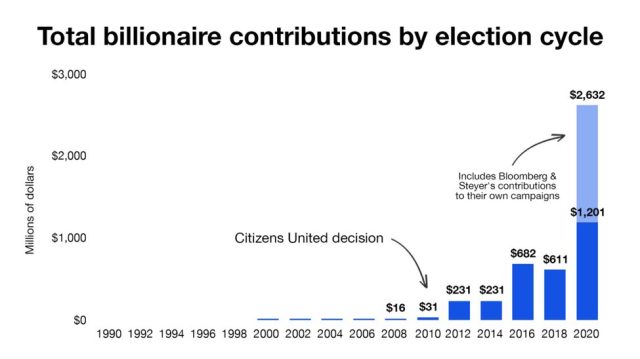
In my mind that chart should convince everyone that an equal playing field does not exist, but it only records contributions up to year 2020. The billionaires were just getting started. Elon Musk alone spent between $288 million to $291 million in support of Trump in 2024 and, as of now, he has committed approximately $160 million in 2026 to his candidates in key midterm races.
After Citizens United, spending by groups that do not disclose their donors (referred to as dark money) has increased and become harder to trace. Records show that dark money groups, “plowed more than $1.9 billion” into the 2024 election cycle.
Democracy Must Be Based on a Set of Rules and Principles
This may be the most fundamental characteristic. In this country, these rules and principles are outlined in the Constitution, and the most important of them are regarded as checks and balances. They include things like presidential vetoes, which Congress can override, the congressional power to impeach and remove a president or a judge, and judicial review, which allows the courts to declare laws passed by Congress, or executive actions as unconstitutional.
Theoretically, these ensure that no branch of government becomes too powerful, but that only works if the rules are followed and a collection of like-minded anti-democracy advocates don’t control all three branches. In light of that qualification, and by way of a warning, multiple commentators have written that the current system of checks and balances is not working.
This change is not a secret. A PBS News/NPR/Marist Poll from February 2026 found that 68% of Americans believe the system of checks and balances is not working well.
The most coherent threat to the Constitution’s attempt to prevent the supremacy of one branch is a Unitary Executive. Donald Trump began his second term ready to transform the American government into an autocracy, or at the very least into an oligarchy dominated by a self-centered gang of billionaires.
The process was outlined in detail before the election in Project 2025, drafted by the conservative Heritage Foundations and more than 100 conservative organizations that aimed to create a president with undivided authority over the entire executive branch and all federal administrative officials. This is often referred to as a “Unitary Executive.”
Below are a few of the Project’s most important components, which clearly describe Trump’s domestic policy up to this point in 2026.
Project 2025 proposed:
— Expanding executive power and dismantling civil service protections by reclassifying tens of thousands of career civil service workers as political appointees, making it easier to fire and replace them with vetted supporters of Trump.
— Ending the independence of the Department of Justice (DOJ) and the FBI from White House political oversight, placing federal law enforcement and prosecutorial decisions directly under the control of the president.
— Employing mass deportation and increased restrictions on immigration as well as increasing detention capacity. This includes a much bigger and more powerful ICE force and many more detention centers.
— Restricting reproductive healthcare and abortion access and seeking to use federal authority to ban or heavily restrict medication abortion nationwide and eliminate all federal funding or support for abortion-related travel.
In case anyone has forgotten, during the 2024 presidential campaign, candidate Donald Trump denied any knowledge of, or connection to, Project 2025.
Foreign Policy Without Regard to Law
Project 2025 outlines a system with no effective checks or balances, but these anti-democratic revisions are not limited to domestic policy. We have already witnessed illegal “unitary” international intervention.
Starting in 2025, Trump ordered a series of armed strikes on small boats off the coast of Venezuela. He claimed, with no evidence, that they were involved in drug trafficking. His actions resulted in the deaths of at least 205 people.
We are now close to seven months since Trump launched the illegal war against Iran on Feb. 28, 2026, violating the separation of powers established by Article I, Section 8, Clause 11 of the U.S. Constitution which grants Congress exclusive power to declare war. At least 7,000 people have died. Most of the victims have been Iranian, some were in the U.S. military and others have been in countries drawn into the fight.
United Nations human rights experts also point to specific violations of the UN Charter, which the United States signed on June 26, 1945.
The United States is Not a Democracy. What Can Be Done?
I realize that what I’ve written is not easy to read, but if you have doubts about anything I’ve written, please look those things up. The current deluge of anti-democratic policies, including Trump’s blatant refusals to abide by laws and traditions, has delegitimized any claim of the United States to being democratic.
There are daily warnings of threats to “Our Democracy.” Clearly Trump’s authoritarian policies should be opposed, but given the present circumstances, these warnings are about as helpful as warning a corpse to stop smoking. The damage has already been done. It is time we all recognize the obvious.
Jürgen Habermas and the Fate of Democracy
When I think about what democracy means, and how we might make it work here, I think of the work of the German philosopher and social theorist Jürgen Habermas, who I was lucky to read when I enrolled in a philosophy class as a university sophomore. I took three additional classes from the same professor, and I believe I remember most of the assigned readings. I made sure to thank him before graduating.
For a short and useful introduction to Habermas I recommend Habermas and the Fate of Democracy written by William E. Scheuerman and published in Boston Review in 2017. I have borrowed some of what is in that article in what I write here.
Habermas made a lifelong effort to work out the conflict between capitalism and democracy so some of it should be easy to transfer to the contemporary United States. He was born in 1929, so he was a very young witness to the Nazi nightmare. In his early journalistic writing, back in the mid-1950s, he criticized much of the older German generation for failing to “take democracy seriously.”
That charge of failing to take democracy seriously is very perceptive. In general, I think most of us in the U.S. fail to take politics seriously. Serious conversation about democracy is not common in most of the media. It is not common in most schools. And, given recent anti-democratic pressure, it is not common in many of our universities.
In case my charges seem overblown I want to present a memorable example of what I mean and what I believe Habermas meant.
Years ago, during a presidential election I was in the weight room of a gym. I don’t remember the year, but no one was listening to the strategically placed televisions broadcasting election news. By contrast, the two guys next to me were engaged in a fascinatingly detailed conversation about a recent televised football game. They both seemed to know more than I ever thought possible about strategy and the talents of individual players.
I can’t remember what was said, but it was impressive, even when I couldn’t follow all the points being made. These guys really took football seriously. That is exactly what Habermas meant about taking democracy seriously. If that is hard for any reader to imagine, I’ve made my point.
Habermas considered democracy an “unfinished project,” that is, something we all must work on. After WWII he even considered democracy a “magic word” that brought together the otherwise disparate voices of Germany’s postwar generation whose members clearly wanted a clean break from Nazism.
In his article, Scheuerman writes that “Habermas’s most important intuition is that democracy rests on public deliberation and exchange.” In other words, it relies on continuous conversation.
He was very clear that all participants should possess equal chances to express their views and must not be unfairly limited when doing so. He believed that “those impacted by any decision must be allowed to deliberate freely and equally about it without being hindered by social inequalities.” That is one component of taking democracy seriously.
In the 1960s Habermas was concerned about “the dismantlement of legal and constitutional safeguards [in some Western Democracies.]” Scheuerman observes that in his later years he was “anticipating the emergence of authoritarian populism, along the lines of Recep Tayyip Erdogan’s Turkey or Viktor Orbán’s Hungary.” Donald Trump has followed their lead in preaching the philosophy of authoritarian populism. He belongs on that list.
If we actually want a democracy, we need to work out what that means. It will take work and time because we must engage in serious conversation about political and institutional reform. We must decide, for example, why we have allowed billionaires to own so much of our media. We must decide why we have allowed those same billionaires to have so much undeserved input into OUR elections. We might, also, think about why we have so many billionaires.
Jürgen Habermas died in 2026 still engaged in conversations.
Jim Mamer is a retired high school teacher. He was a William Robertson Coe Fellow for the Study of American History at Stanford University in 1984. He served as chair of the History and Social Sciences department for 20 years (first at Irvine High and then at Northwood High). He was a mentor teacher in both Modern American History and Student Assessment. In 1992 he was named History and Social Sciences Teacher of the Year by the National Council for the Social Studies (NCSS).
Artwork:
The color image is a painting by Peter Carr titled This Is How We Will All Be Saved, used courtesy of Andrew Tonkovich’s Collection. The black-and-white image is also by Carr, titled Now That We Are Here, and is likewise used courtesy of Tonkovich’s Collection. The paintings are part of an exhibition of Peter Carr’s work currently on view at the Carolyn Campagna Kleefeld Contemporary Art Museum at Long Beach State University. The exhibition runs through December 10, 2026.
Editor’s Note: At a moment when the once vaunted model of responsible journalism is overwhelmingly the play thing of self-serving billionaires and their corporate scribes, alternatives of integrity are desperately needed, and ScheerPost is one of them. Please support our independent journalism by contributing to our online donation platform, Network for Good, or send a check to our new PO Box. We can’t thank you enough, and promise to keep bringing you this kind of vital news.
You can also make a donation to our PayPal or subscribe to our Patreon.