

Steve Wasserman ScheerPost
An ill wind is blowing through Europe (and not only there, as we know from these last frightening years in America). It is possible to travel through Germany by train and gaze at the well-manicured farms out your window, populated by well-fed cattle and beautiful horses, sturdy attractive homes beneath cloudless skies and graced by curated forests of pines and oaks, and convince yourself that what appears serene and prosperous today will (somehow) be so tomorrow. But there is a chill in the air even as the blistering heat of summer begins to subside.
Germany, in particular, so aware, since the defeat of fascism eighty-one years ago, of its responsibility for the bloody dictatorship that plunged the world into a war in which millions died, has taken admirable steps to make sure it never again becomes a republic of amnesia or imperial ambition.

Thus, the exemplary monuments and museums devoted to historical memory over forgetting that are everywhere to be seen. Many of the most moving are not immediately evident but are to be found literally under your feet.
As Wendy Lesser writes in her engaging new book, “Berlin Before and After: A Cautionary Mirror for Our Times,” the memorial marking the notorious Nazi book burning of May 1, 1933, can easily be missed since its “just a ground-level square of clear glass set among the paving stones” on the Bebelplatz in central Berlin. It was there that “the Nazis publicly destroyed the works of Alfred Döblin, Bertolt Brecht, Albert Einstein, Walter Mehring, Erich Maria Remarque, Thomas Mann, Werner Hegemann, and countless other authors.” At least 25,000 books were consumed in the auto-da-fé.
By chance, I happened to look down as I crossed the plaza and there it was. The brass plaque that briefly tells the story of this terrible event is bolted to the ground. It bears a saying by the great German-Jewish poet Heinrich Heine who wrote in his 1821 play “Almanso”: “Whomsoever burns books in the end will also burn human beings.”
Under the glass appears, as Lesser notes, an “all-white underground sculpture [that] consists of empty shelves lining the walls of an otherwise bare room. What looks like a glass picture-frame from above is a skylight or peek-hole set into the white room’s ceiling, so that you are peering down into it from the plaza.” It was created by the Israeli artist Micha Ullman.
A few days later, I traveled to the Baltic Sea resort Graal-Müritz to participate in a literature festival. There I would interview the great German director Hans-Jürgen Syberberg who, at almost 91, remains a nearly toxic figure in German cinema, largely for having the temerity to insist on the close connection between despotism and the dreams and delusions shared by millions of ordinary people. The pathology of the criminal mind is what interests him and the way in which there is almost always an unconfessed and secret love between a people and a tyrant. In the region where Graal-Müritz is located the far-right party AfD fell just under the threshold for obtaining a majority in the recent elections. But one has the impression that the party has the wind at its back.
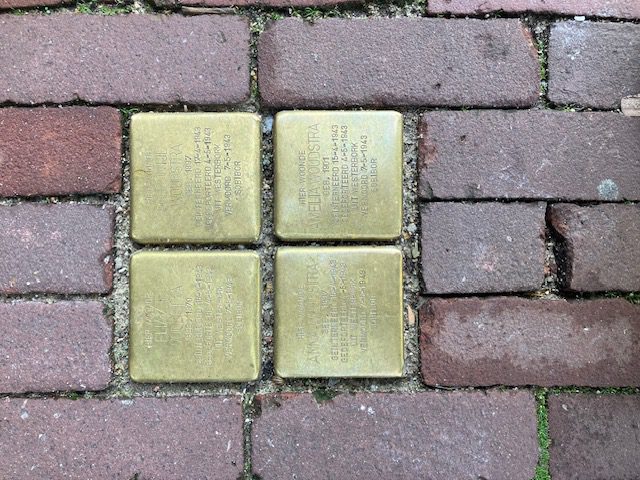
Elsewhere signs of the unraveling of the postwar consensus mount as memory fades. The brass stumble-stones that have been placed since 1990 in the sidewalks in front of thousands of homes where Jews and other persecuted people were forced to flee and many deported to their deaths, which have helped remind people of the country’s shameful history and, with luck, act as a prophylactic to prevent future calamity, are now, in some quarters, being renounced. A few days before departing Germany, I awoke to the alarming news that the town of Heidenau, near Dresden, had voted to ban such memorials, arousing fierce criticism in some quarters, including Germany’s Minister of Education who condemned the ban as a “scandal.” The ban was promulgated by the AfD in concert with the conservative Christian Democratic Union.
One has the feeling that beneath the ostensible peace and prosperity, demons of bigotry and resentment, hurt and hatred, are gathering. I fear for the future.
Steve Wasserman, a former editor of the Los Angeles Times Book Review, is publisher of Heyday Books, a nonprofit, independent publishing house founded in 1974 in Berkeley, California. He is the author of Tell Me Something, Tell Me Anything, Even If It’s a Lie: A Memoir in Essays.
Please share this story and help us grow our network!
Editor’s Note: At a moment when the once vaunted model of responsible journalism is overwhelmingly the play thing of self-serving billionaires and their corporate scribes, alternatives of integrity are desperately needed, and ScheerPost is one of them. Please support our independent journalism by contributing to our online donation platform, Network for Good, or send a check to our new PO Box. We can’t thank you enough, and promise to keep bringing you this kind of vital news.
You can also make a donation to our PayPal or subscribe to our Patreon.